PEN International and Young Writers Committee Supports a Rohingya Writer's Debut in Cox's Bazar
by Ege Dündar
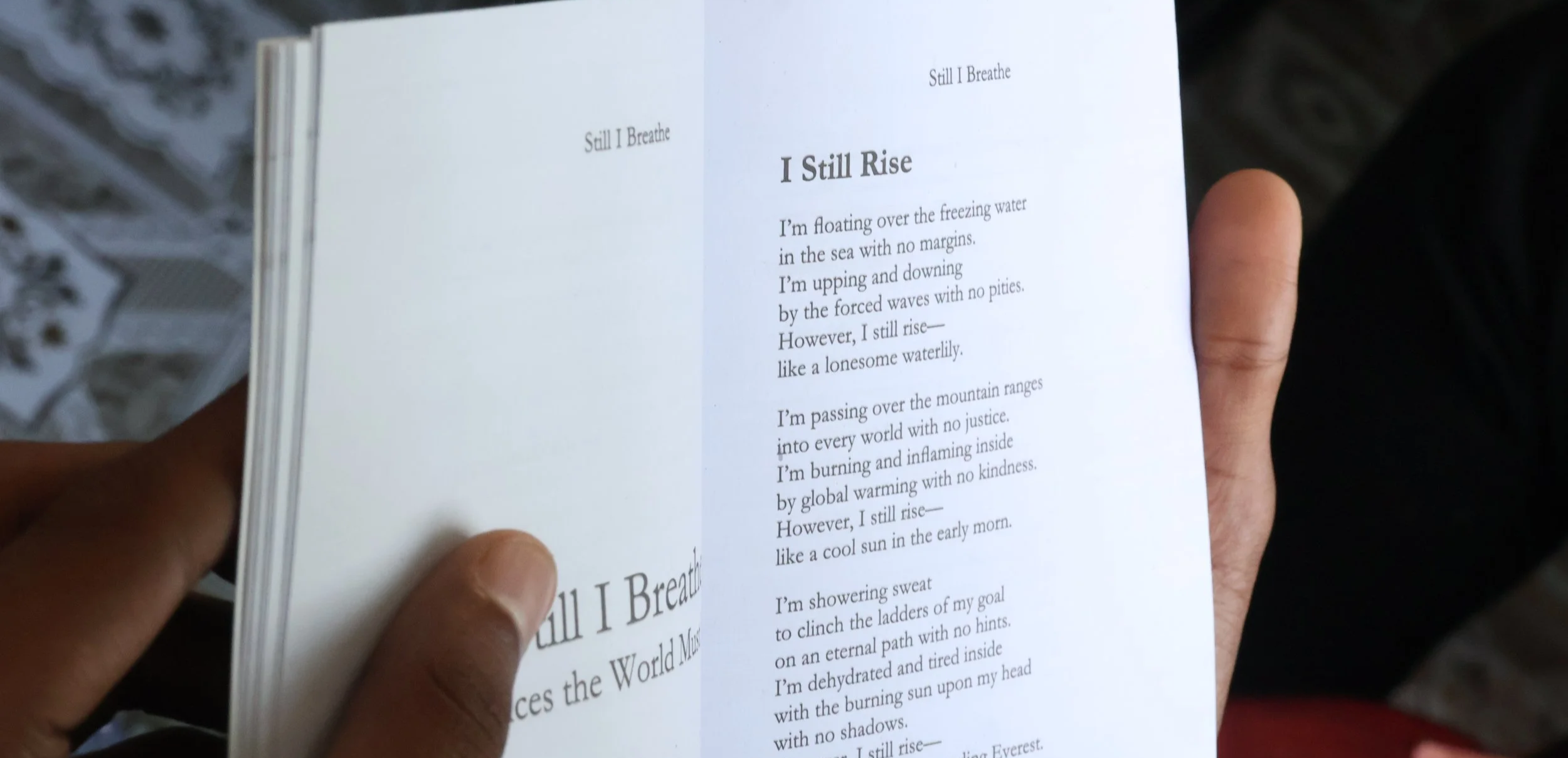
Image Credit: Ro Hefzu
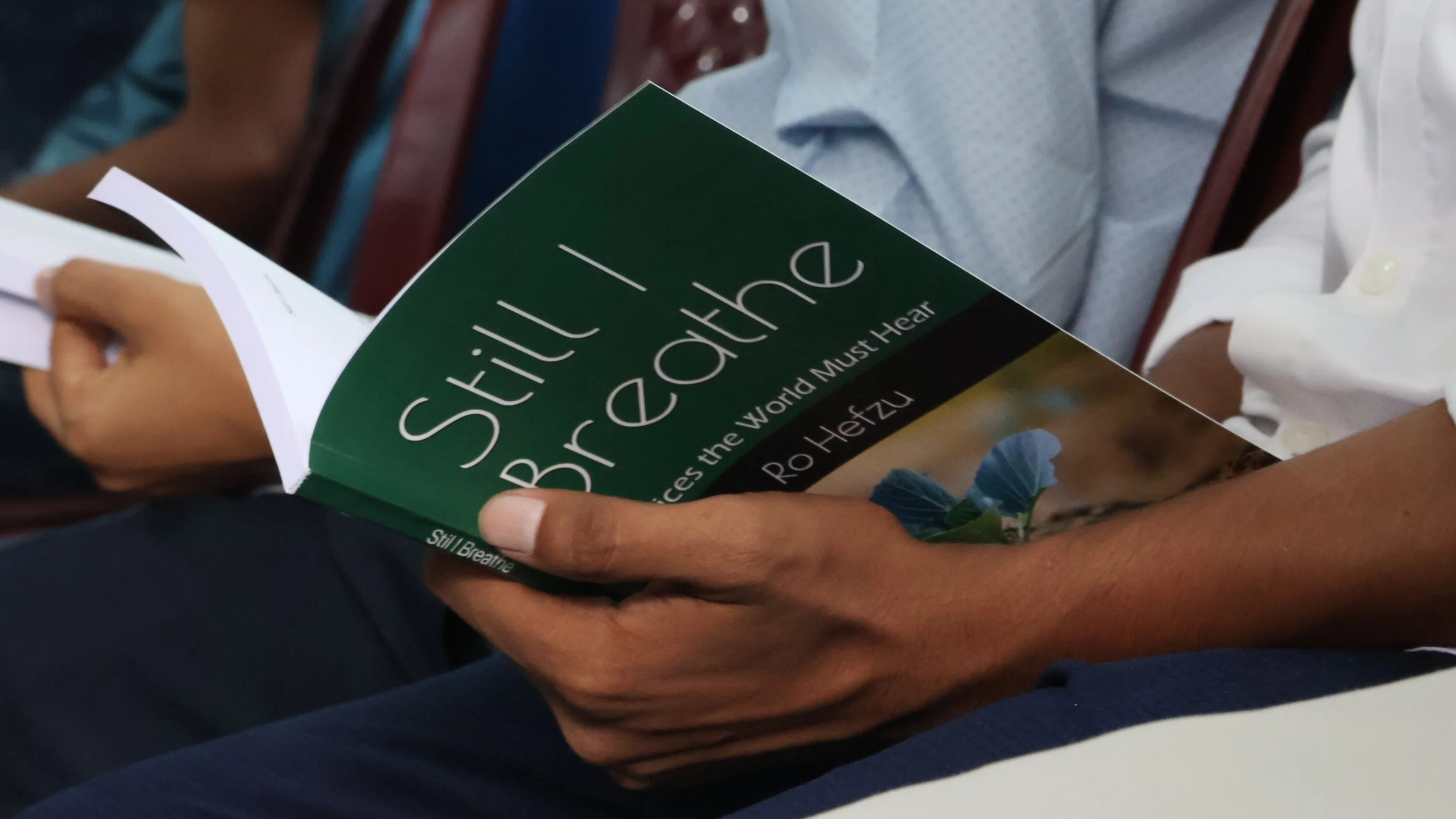
PEN International supported a literary gathering in the world's largest refugee camp, Cox's Bazar, for the debut book launch of young writer Ro Hefzu's Still I Breathe, supported by fellow Rohingya writers Mayyu Ali and Sirajul Islam.
Ro first made contact with Tomorrow Club, where his poetry and an interview with him were featured. His commitment to choosing literature and storytelling over the violence and genocide he was subjected to, and his determination to educate his peers and uplift his community despite some of the harshest conditions and cultural erasure imposed upon him, inspired all of us.
Described by UN Secretary-General António Guterres as "one of, if not the most, marginalised people in the world," Rohingya refugees are not permitted to leave the camp or continue their education, and are forced to survive on $12 a month, the same amount it cost to buy a copy of Ro's debut book. Ro reached out to PEN International explaining that he could not afford to distribute his own book to friends and family in the camp.
PEN International stepped up, providing support through the facilitation of Mayyu Ali, a fellow, older and renowned Rohingya writer living in Canada, whom we connected with at our most recent Congress in Kraków and who regularly visits the camp for literary activities and to publish Rohingya literature through his own publishing house. Still I Breathe was printed and distributed at the event, alongside refreshments and a letter of appreciation on behalf of PEN International.
Ro had also kindly asked for a foreword to his book, Still I Breathe: Voices the World Must Hear. A fuller account of the event, in his own words, is available in his post-event report. Read my full address below.
Cox Bazaar, Bangladesh. 14 August 2026
Hello Ro and everyone.
It's an honor to be here with you today, even if it is from a camera. I do hope to be at in person someday soon. Thank you for inviting me for a speech. I've been thinking, why do we write and why does it matter? I often face and contemplate this question, and being here with you today is I think one of the core reasons why. I'm grateful to being connected with you Ro and your peers there through the power of words and rightful anger and injustices. We are of the same generation roughly, thousands of miles apart with both our homes taken from us, me away from my home Turkey and you in Bangladesh. And many of our brothers and sisters beyond this room across borders are speaking out and organizing for losing the prospects of their future. They're trying to be smarter, peacefully uplifting their communities against unimaginable shared atrocities. But when a mudslide happens there, or an earthquake in my country, I know we feel for each other's pain deeply. I don't know how many of us are out there, but less is more, some wise men say.
We focus on amplifying brave young voices on Tomorrow Club at PEN International, as you know, and we are honoured that you are one of them. Because you and our generation, especially those in the global majority, have a lot to say and do need to reclaim our futures, our hopes, our prospects, in the very least, our most basic human rights. By writing, you resist cultural erasure with such conviction. By writing, you bring the unspeakable acts of a genocide you were forced to witness as a child. And now people younger than you face similar struggles, near and far, as violence, oppression, and corruption spreads around the world. And you, raise your voices for them.
A sense of loss and inequality has grown everywhere, especially with autocratic corruption, polarizing technologies, migration crisis, environmental breakdown, all coupled together threatening us all. In this bleak context, meeting you and your work as well as your peers like Sirajul Islam and Mayu Ali have shown me how quitting can never be an option for us. How to have hope or not to have hope is just a luxury. The reality is that enormous effort is needed to survive and sustain your loved ones. You reminded me and all who read your story that still we breathe. And I'm humbled by and salute all your efforts every day to keep writing, pushing, learning, and growing despite all inhumane limits imposed on you. Not just for your own storytelling or literature, but for community. Not art as luxury, but as an existential tool to uplift humans around you and connect with others across borders.
I consider myself lucky to have connected from such a long distance between us through writing and to be able to learn from you and pass your words along as far and wide as we could on our platforms which run on a voluntary small budget basis. I have to say that whomever I met that have read your poems on our website or heard your voice on our podcast or heard news of your book have reflected with deserved praise of your work, your commitment to speaking up and organizing peacefully against all the violence subjected to your people. That is why today deserves a much bigger congratulation than just for publishing your first book, but rather for being who you are.
This young man, whose home and educational aspirations were taken from him through a violent genocide and cultural erasure, whose community and family was forced to live with $12 a month with inadequate health care facilities, with restrictions on leaving the largest refugee camp in the world, was still writing about Palestine, decrying the silence so many carry with them in their comfortable numbness. He was quoting Martin Luther King in our interview that no one is really free until all of us are free. The same chance filled the streets in Turkey, in my home country, recently in demonstrations to come together against the government's autocracy.
Albert Camus, who is the youngest person to win a Nobel Literature Prize, gave a lecture in 1967 to a group of students in Sweden shortly after receiving the award. You can find his brilliant speech in the short book Create Dangerously. He said something like the unfair conditions for the majority of the world have burst upon our contemporary sensibilities, whereas some had a tendency to forget them. In the face of so much suffering, if art insists on being a luxury, it will also be a lie.”
Words in cultures across history like Kapwa in the Philippines, Aham Brahmasmi in ancient Sanskrit and Ubuntu in Zulu all express this concept of a shared self, a shared humanity. I am because we are. You and I are not separate. We are the universe. That spirit is ultimately what's going to bring about the awakening young people are fighting for around the world, and it comes strongly through Ro, both as a person and in his writing.
He demonstrates how our hearts can expand to encompass a care far beyond the self, despite how limited our circumstances have become. A strong lesson many have to learn about how we can cultivate hope against the worsening circumstances and action for the majority of people in the world. The book shows the power of literature against the strongest powers and harshest circumstances and inequalities. From A bird's eye view, it is moving and inspiring to see it alongside other brave young voices standing up against adversity all around us beyond this room. We surely need to come together.
And literature, creative expression can be a potent bridge, a resistance to cultural erasure, polarization, and demonization. It can open new windows and widen consciousness. It can bring towards our collective yearning for coming together for a better home, with much more urgency for some than others, but ultimately for all of us.
Lastly, I want to say that this care you and your colleagues there show for building community around stories and speaking up is an example for us and younger peers everywhere, especially in the global minority. Some of them are lost in hopelessness, cynicism, nihilism and escapism in the face of a world increasingly experiencing instability, loss of prospects and rights while struggling to cope with it. Now they can learn from you and they have another book they can read to help. Let's keep raising our voices and connecting across borders. I hope inshallah to meet you and your friends in person, Ro Kardeş, which means brother in Turkish. May your ink be plenty and your path clear. Welcome to the endless bookshelves of history and our new young writers community. Congratulations.
Still I Breathe is available on Amazon. Further information on Ro's work is available via Tomorrow Club.