
Bangladesh: Assault on four journalists highlights mounting threats to press freedom
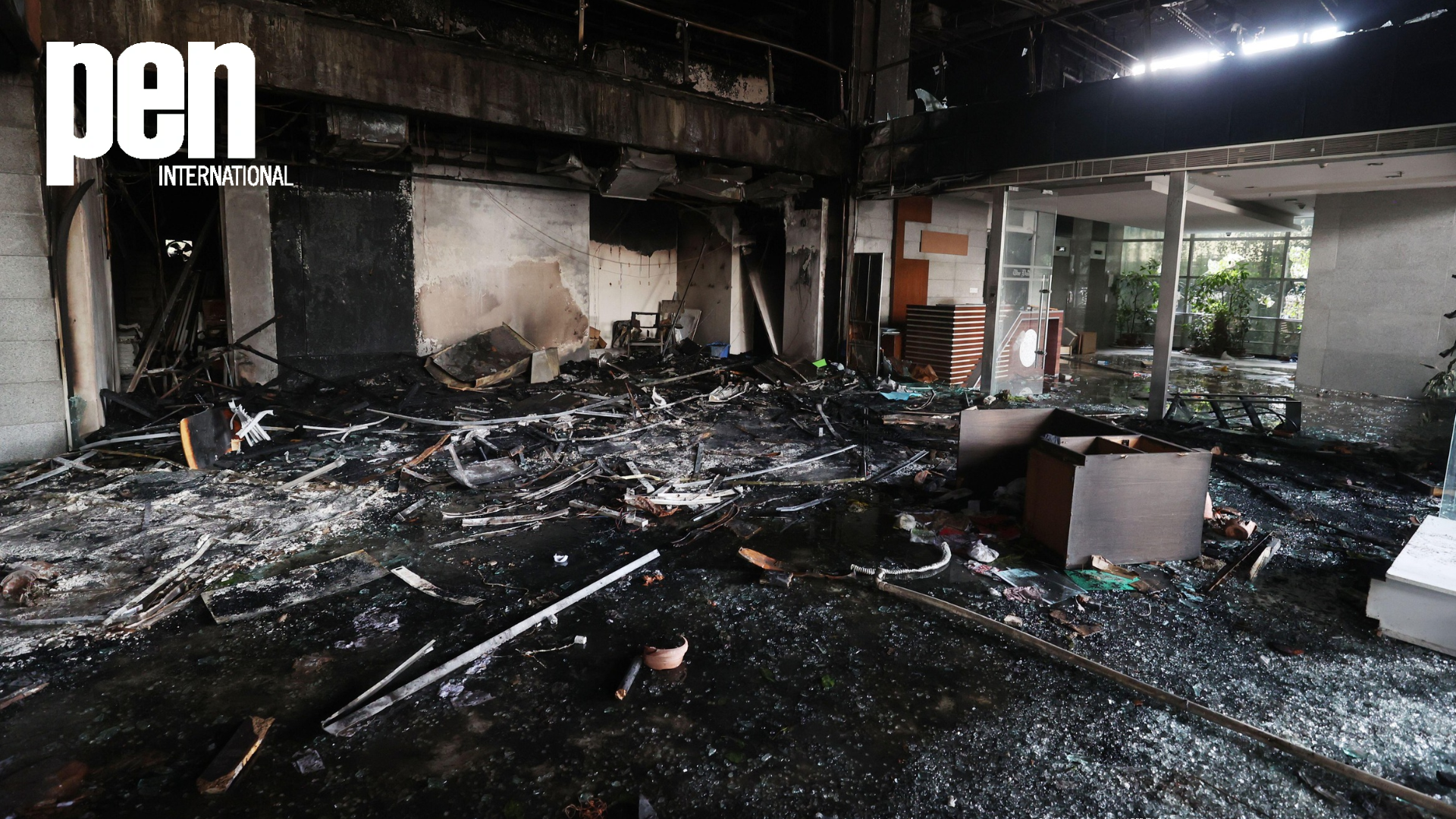
Image Credit: SK Hasan Ali
The aftermath of the arson attack on The Daily Star offices, Dhaka, Bangladesh, December 2025.
‘When journalists are attacked for documenting violence and holding those in power to account, it is not only their safety that is at stake, but the public’s right to be informed. No political party that claims to defend fundamental rights can tolerate violence against the press or allow those responsible to escape accountability. Bangladesh’s promise of a freer society must be reflected in the protection of journalists, not undermined by intimidation and impunity,’ said Ma Thida, Chair of PEN International’s Writers in Prison Committee.
21 October 2026: PEN International condemns the brutal assault on four journalists at Rajshahi University on 4 October 2026, allegedly by members of Bangladesh Jatiyatabadi Chhatra Dal (JCD), the student affiliate of the ruling Bangladesh Nationalist Party (BNP). The attack comes amid persistent threats to press freedom in Bangladesh, where journalists have faced physical assaults, threats, and intimidation in recent years. Despite changes in government, these incidents have continued to undermine independent journalism, fuel self-censorship, and raise concerns about impunity for those responsible. PEN International urges the Bangladeshi authorities to ensure prompt, thorough, independent, and effective investigations into all crimes against writers and journalists, and to bring those responsible to justice.
The journalists were reportedly attacked on 4 October while documenting a group of JCD activists carrying weapons, including machetes, hockey sticks, and bats, who were allegedly seeking to assault a student union leader over a social media post. At least 10 people were injured in the incident, including Nur Ahsan Mridul of The Daily Star, Zahidul Islam of Agamir Shomoy, Arifuzzaman Korban of bdnews24.com and Mainul Islam Raju of Samakal. Reports indicate that the journalists were assaulted while carrying out their professional duties, and that colleagues who attempted to intervene were threatened. Attempts were made to seize journalists’ phones and prevent them from recording the incident.
The incident raises serious questions about accountability. The university administration filed a police case, and both the university and JCD established investigation committees. However, reports suggest that progress towards holding those responsible to account has been limited. JCD reportedly expelled two leaders and one activist following the assault. Internal disciplinary measures, however, cannot substitute for criminal accountability.
The assault is part of a wider pattern of threats and violence against journalists across Bangladesh. On 15 October 2026, unidentified gunmen shot and killed journalist Lutfozzaman Fakir Alif in northern Bangladesh. Alif investigated suspected corruption and criminal organisations. The day before, on 14 October, at least three journalists were reportedly harassed while covering a clash between two JCD factions in Kushtia. Party activists allegedly confronted journalists who attempted to film the altercation and tried to delete their footage.
On 25 August 2026, three journalists covering a BNP rally in Shariatpur were allegedly punched, slapped, and kicked by party leaders and activists. One journalist reported that a BNP leader snatched his phone and tore his press identification card. The same leader reportedly threatened further violence against journalists, claiming that the party had a list of journalists it intended to target. Other reported incidents in recent months have involved alleged assaults by political activists in Jhenaidah and Jashore. The Bangladesh Association of Journalists documented 51 cases of attacks, legal harassment, threats, and professional obstruction in August 2026 alone.
Threats to press freedom extend beyond street assaults. In December 2025, mobs attacked the offices of The Daily Star and Prothom Alo in Dhaka, setting fire to buildings and forcing both newspapers to suspend publication temporarily. Subsequent reporting noted that journalists had begun to conceal their professional identities and exercise caution over coverage that might be politically sensitive, highlighting the chilling effect of this violence on independent reporting.
The pattern has persisted through changes in government. Under former Prime Minister Sheikh Hasina, whose 15-year rule was widely characterised as authoritarian, journalists faced restrictive laws, surveillance, arrests, and pressure on media outlets.
Following Hasina’s ouster in August 2024, the BNP retunred to power promising to protect press freedom and defend journalists from attacks and intimidation. However, repeated allegations of violence involving party members and affiliates raise serious questions about whether those commitments are being honoured. In December 2025, the UN human rights office expressed concern that the interim government had ‘largely followed the previous patterns of impunity, normalising attacks and threats without consequences for the perpetrators,’ underscoring the persistent failure to protect writers and journalists and hold perpetrators to account.
The assault at Rajshahi University underscores the continuing threats facing independent journalism in Bangladesh. Political transitions alone cannot guarantee press freedom. When journalists face violence and intimidation for documenting events and scrutinising those in power, the risk of self-censorship grows, undermining both freedom of expression and the public’s right to access information. Holding those responsible to account is essential to preventing further attacks and ensuring meaningful protections for journalists.
Note to Editors:
For further information, please contact Michael Rosen-Lupu, Head of the Asia-Pacific region at PEN International, email: [email protected]
For media queries, please contact Sabrina Tucci, Head of Communications and Campaigns at PEN International, email: [email protected]