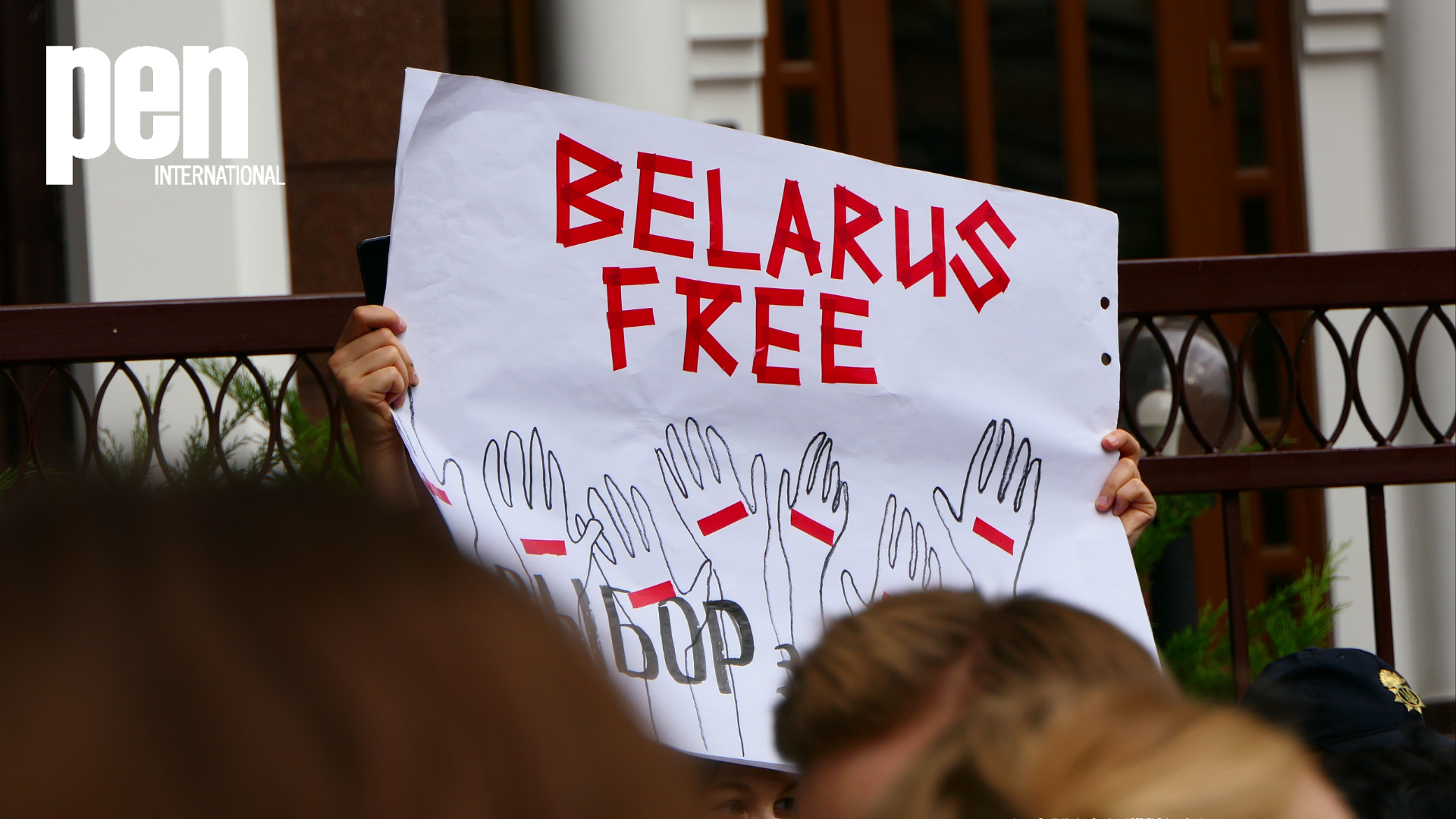
Image Credit: Oleksandr Polonskyi/Shutterstock
‘We stand with the fearless Belarusian cultural figures who continue to create in the most challenging circumstances – both at home and in exile. On this fateful day, we reiterate calls on the international community to do everything in its power to support Belarusian culture and to ensure justice and accountability,’ said Ma Thida, Chair of PEN International’s Writers in Prison Committee.
7 August 2026: Six years after the fraudulent presidential election of August 2020, the Belarusian authorities continue to systematically suppress any form of dissent, PEN Belarus and PEN International said today. The crackdown escalated from the targeting of peaceful protests to the current system of governance in which language, historical memory, literature, art and participation in cultural life are assessed through the lens of political loyalty.
Despite releases from prison in 2025 and 2026 following negotiations aimed at lifting economic sanctions, many Belarusian writers continue to be deprived of their liberty on politically motivated grounds. At least 122 cultural figures, including 22 writers and other literary professionals, remain imprisoned or under house arrest at the time of writing. Releases have taken place alongside new arrests and the opening of criminal cases on spurious grounds. Many cultural figures were forcibly expelled from Belarus and released into exile, had their passports confiscated or remained on the Belarusian authorities’ lists of ‘extremists’ and ‘terrorists’. At the same time, the number of banned books rose to at least 369.
The overall scale and structure of violations demonstrate that repression by the Belarusian authorities has not weakened but changed form. PEN Belarus documented 1435 violations of cultural rights and of the human rights of cultural figures in 2025, compared with 1348 in 2024. A further 738 violations were recorded between January and June 2026 alone. Censorship and the designation of cultural materials, books and social media pages as ‘extremist’ have become the most widespread practices. Combined monitoring data show that state cultural policy is increasingly institutionalising repression, suppressing diversity and subordinating the cultural sphere to ideological and administrative control.
Over the past year, the Belarusian authorities have extended repression to entire cultural ecosystems. Staff of independent publishing houses and book distributors have faced mass arrests and criminal prosecution. Publishing houses operating abroad, film festivals, educational projects, heritage initiatives and PEN Belarus itself have been labelled ‘extremist formations’. Such decisions criminalise not only cultural work but also cooperation with independent initiatives, financial support and access to materials. Meanwhile, in Belarus, the Register of Organisers of Cultural and Entertainment Events has become a mechanism of ideological licensing. Festivals and performances are cancelled, informal blacklists continue to expand, and independent cultural infrastructure is either shut down or brought under direct state control.
Belarusian cultural and national identity remains a central target of these policies. The Belarusian language, national symbols and independent interpretations of history are increasingly treated as markers of ‘opposition’. Those detained are punished for using the Belarusian language, books are removed from prison libraries, and manuscripts drafted in captivity are confiscated or destroyed by prison authorities.
Historical memory is being rewritten through censorship as well as the destruction and distortion of memorial sites, while official cultural policy promotes Russification, militarisation and deeper integration with Russian state institutions. The 2026 report of the UN Special Rapporteur on the situation of human rights in Belarus places cultural rights, language and historical identity at the centre of its assessment of the authorities’ continuing repression.
Inside Belarus, independent cultural life is increasingly being forced underground, into anonymity and self-censorship. Outside Belarus, exile offers relative safety but not complete protection: cultural figures face trials in absentia, the confiscation and sale of their property in Belarus, threats, pressure on relatives and arbitrary invalidation of identity documents. At the same time, independent publishers, artists, festivals and cultural organisations abroad strive to preserve the Belarusian language, cultural memory and professional continuity – the very activities that the Belarusian authorities are now seeking to criminalise.
‘The right to speak, write, create, remember and participate in cultural life belongs to everyone and is an essential condition for a free future for Belarus,’ said Taciana Niadbaj, President of PEN Belarus.
PEN Belarus and PEN International call upon the Belarusian authorities to immediately and unconditionally release all cultural figures and others deprived of their liberty merely for peacefully exercising their views. The authorities must end all acts of censorship and transnational repression, the forced expulsion of former prisoners, and the destruction of creative works and manuscripts. Anti-extremism legislation should not be used to suppress participation in cultural life.
The international community should not consider the releases of those held on politically motivated grounds as evidence of progress while the underlying roots of repression remain unchanged. Governments and international institutions must demand accountability, provide sustained support for independent Belarusian culture and protect Belarusian cultural figures at risk – both inside Belarus and abroad – including assistance with identity documents, the regularisation of legal status, medical care and professional integration.
Additional information
For more information about the work of PEN Belarus, including their monitoring of cultural and human rights violations against cultural figures, please click here.
For more information about PEN International’s work on Belarus, please see Writers under Siege: Defying Silence – its Case List 2026
Note to editors:
For further details contact Aurélia Dondo, Head of Europe and Central Asia Region at PEN International: [email protected]
For media queries, please contact Sabrina Tucci, Head of Communications and Campaigns at PEN International: [email protected]