
Belarus: Statement on the systematic confiscation and destruction of manuscripts by prison authorities
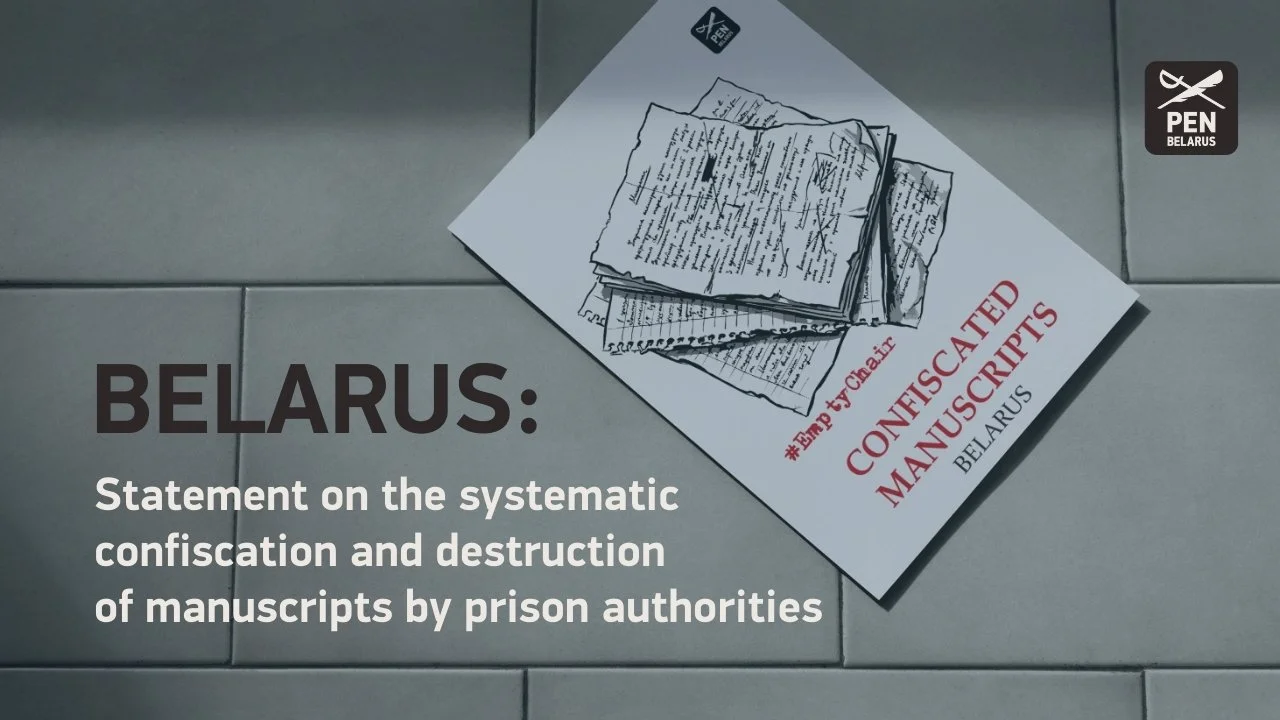
3 March 2026: In Belarus, prison authorities systematically confiscate and destroy the literary manuscripts and letters of those imprisoned on politically motivated grounds. Their aim is not only to silence individuals, but also to dismantle their human and cultural identity and erase the intellectual and cultural heritage created even in isolation. By destroying manuscripts, the authorities seek to deprive authors of the opportunity to bear witness to their time and to maintain a connection with society. They further intend to erase evidence and society’s right to memory. PEN Belarus considers these actions to be a form of cultural and psychological violence.
These systematic violations of human rights and of international and national legal norms deliberately suppress human dignity and attempt to erase the voices of those who dare to think and create in the face of repression.
In recent years, we have documented numerous cases in which:
memoirs, autobiographical essays, and diary entries are arbitrarily confiscated during cell searches and not logged in official records;
literary works, poems, and philosophical reflections are taken by prison authorities prior to the transfer of prisoners (including before their release);
personal notes, letters, and drafts of cultural value disappear after being seized;
completed manuscripts or written fragments are not sent to relatives and loved ones and remain arbitrarily with censors.
Documented individual cases
The sheer scale of destruction of intellectual property by the Belarusian authorities is alarming and affects writers, literary figures, and activists alike. Similar practices have been recorded in various institutions and against both men and women.
Maryja Kalesnikava saw the manuscripts of two books confiscated; Alena Hnaŭk lost all her correspondence; and Hanna Kurys had her prison drawings and other creative works seized. The women were held in Penal Colony No. 4 in Homiel.
Nobel laureate Aleś Bialacki (Penal Colony No. 9 in Horki, Mahilioŭ region) reported that on the day of his release, the authorities took all his manuscripts and the few letters that had reached him in detention. Among the confiscated materials were two draft memoirs.
Such practice amounts to psychological violence. The administration of Penal Colony No. 15 in Viejna (Mahilioŭ region) notably coerced Alaksiej Hajšun into destroying the manuscripts of three books he had written while in detention.
According to documented testimony, upon his release from the KGB pre-trial detention centre in Minsk, Mikoła Dziadok had around 20 kilograms of letters, notebooks, and diaries confiscated.
Maksim Znak (Penal Colony No. 3 in Viciebsk region) reported the confiscation of manuscripts of literary works, poems, translations, and song lyrics. He noted that before his release, all items bearing any writings were taken from him.
Ihar Karniej (Penal Colony No. 20 in Homiel region) had all his notes, diaries, and notebooks seized: “They searched for an hour and a half — every seam, every sheet, all the notes (they took my notebook then; the others had already been destroyed in Škloŭ).”
Uładzimir Łabkovič (Penal Colony No. 17 in Škloŭ, Mahilioŭ region) had the manuscript of an essay about Vasil Bykaŭ confiscated.
Pavieł Sieviaryniec (Prison No. 1 in Hrodna) saw all his written works confiscated.
Alaksandr Fiaduta (Penal Colony No. 15 in Mahilioŭ) stated: “My manuscripts were confiscated. There were no political notes, no diaries. There was no information related to my imprisonment. There was a screenplay, two plays, and two notebooks of poems.”
These actions are not isolated incidents. They constitute a systematic policy of cultural repression and bear the hallmarks of cultural censorship and deliberate cultural destruction aimed at depriving political prisoners of their voice, their memory, their ability to bear witness to what they have endured, and their opportunity to comprehend reality through creative expression.
Such actions represent a grave and systematic violation of fundamental cultural rights enshrined in international human rights law and standards – to which Belarus is a state party – and in the national legislation of Belarus.
1. The right to freedom of expression
Article 19 of the Universal Declaration of Human Rights; Article 19 of the International Covenant on Civil and Political Rights; Article 33 of the Constitution of the Republic of Belarus.
Every person, including when deprived of liberty, has the inalienable right to freedom of opinion and expression, and the right to impart information and ideas through any media. The destruction of manuscripts is a direct act of censorship of personal self-expression – an attempt to silence those who are restricted or deprived of other means of communication with the outside world. The Belarusian authorities do not merely unduly restrict freedom of expression; they physically destroy its material embodiment.
2. The right to be free from torture or cruel, inhuman or degrading treatment, and the right to dignity
Article 5 of the Universal Declaration of Human Rights; Articles 7 and 10 of the International Covenant on Civil and Political Rights; Article 25 of the Constitution of the Republic of Belarus.
All persons deprived of liberty have the right to humane treatment and to respect for the inherent dignity of the human person. The confiscation of manuscripts by prison authorities degrades human dignity. Creative work in detention is a fundamental need of the human spirit — a way to preserve reason, identity, and hope.
Under Article 1 of the UN Convention against Torture, torture is defined as any act by which severe pain or suffering, whether physical or mental, is intentionally inflicted on a person for purposes such as intimidation or punishment.
For a writer or scholar, the result of their intellectual work is inherent to their personality and the principal means of professional fulfilment. The conditions of isolation in which political prisoners are held turn creative work into a vital mechanism for preserving mental health and human dignity. The deliberate destruction or confiscation of manuscripts created over years in harsh conditions constitutes a form of psychological violence aimed at the “intellectual destruction” of a person.
The above-mentioned norms of international and national law explicitly prohibit torture and cruel, inhuman, or degrading treatment or punishment. Confiscating manuscripts without lawful and reasoned documentation or explanation turns this process into an arbitrary act of abuse of power, effectively imposing additional punishment on a prisoner for their thoughts. It becomes a deliberate destruction of creative work intended to break human dignity.
3. The right to participate in cultural life
Article 27 of the Universal Declaration of Human Rights; Article 15 of the International Covenant on Economic, Social and Cultural Rights; Article 51 of the Constitution of the Republic of Belarus.
Everyone has the right to freely participate in the cultural life of the community. Deprivation of liberty does not remove a person’s cultural rights. On the contrary, international law recognizes that even in detention people must be able to engage in creative activity, produce cultural works, and participate in cultural life to the extent compatible with the conditions of imprisonment.
International standards for the treatment of prisoners, in particular the Nelson Mandela Rules (the UN Standard Minimum Rules for the Treatment of Prisoners), explicitly state that imprisonment does not suspend cultural and educational rights. Under Rules 64 and 105, prisoners must have opportunities for cultural activities and intellectual development in order to maintain mental health and human dignity.
The confiscation of manuscripts deprives prisoners of:
the right to create – to produce literary, philosophical, and memoir works;
the rights of authorship – to preserve and transmit their works for publication and to protect the moral and material interests arising from any works of which they are the author;
the right to cultural heritage – to leave testimony of their time for future generations;
the right to connect with the cultural community – to share their thoughts, experiences, and creative work with the outside world.
It also violates the rights of potential readers, who are denied the opportunity to read the author’s work. The manuscripts of political prisoners are historical documents. Their destruction is an attempt to erase historical memory. This violates not only the rights of the prisoners themselves, but also society’s right of access to cultural and historical heritage. The confiscation of manuscripts is an act of cultural vandalism comparable to the destruction of historical archives or works of art.
History offers many examples of manuscripts created in detention that later became major literary works: New Land by Jakub Kołas, The Travels of Marco Polo, The City of the Sun by Tommaso Campanella, Don Quixote by Miguel de Cervantes, De Profundis by Oscar Wilde, the books of Alexander Solzhenitsyn, and the diaries of Nelson Mandela. In this line of world-renowned names, one tragic page in our own cultural history is the translation of Homer’s Iliad, produced in detention by Branisłaŭ Taraškievič in the 1930s. The complete manuscript was later confiscated by the Soviet authorities, and its fate remains unknown to this day.
Each of these works is not only a personal story, but also testimony to an era – a document without which our understanding of history would be incomplete. Belarusian prisoners are writing history right now. Their manuscripts are not only monuments to courage and to their time but also works of art and philosophy. The confiscation of these manuscripts is evidence of cultural censorship and the deliberate destruction of intellectual heritage.
The systematic destruction of writers’ manuscripts in Belarus goes far beyond the violation of cultural rights and constitutes a practice aimed at dismantling the individual and erasing their intellectual and creative presence.
We urgently call on the authorities of Belarus, in particular the Ministry of Internal Affairs and the Department for the Execution of Sentences, to:
Immediately cease the practice of confiscating the manuscripts of political prisoners.
Immediately return all existing manuscripts to their authors (rights holders).
Ensure the realisation of the cultural rights of political prisoners.
Bring current practices into compliance with international and national legal standards.
We further call on the international community, the UN Special Rapporteur in the field of cultural rights, the UN Special Rapporteur on the situation of human rights in Belarus, UNESCO, as well as international human rights organisations to:
public condemn the confiscation and destruction of manuscripts by prison authorities;
include this issue in reports and resolutions by international bodies;
send formal inquiries to the Belarusian authorities demanding that prisoners’ cultural rights be upheld;
monitor cultural and educational rights in places of detention.
Endorsed by:
PEN International
PEN Català
PEN Denmark
PEN Finland
PEN Norway
PEN Sweden
Belarus 2020 Foundation
Belarusian Association of Journalists
Belarusian Council for Culture
Belarusian Cultural Society “Сhatka”
Belarusian Helsinki Committee
Belarusische Gemeinschaft RAZAM e.V.
Civic Cultural Campaign “Budźma Belarusami!”
Creators’ House Foundation
Czabor Association
Human Constanta
Krystsina Drobysh, audiobook publisher
Lawtrend
Legal Initiative
RAZAMKUNST
Telegram channel Holybelawood
Tutaka Foundation
Tuteishy Theatre
Viasna Human Rights Center
Additional information
For more information about the situation for freedom of expression in Belarus and the authorities’ onslaught on cultural and linguistic rights, please see PEN Belarus, PEN International, and PEN America’s joint submission to the UN Human Rights Council.
To learn more about the work of PEN Belarus, including its monitoring of violations of cultural and human rights affecting cultural figures, please click here.