
Egypt: Poet Ahmed Douma arrested for speaking up against human rights violations in prisons
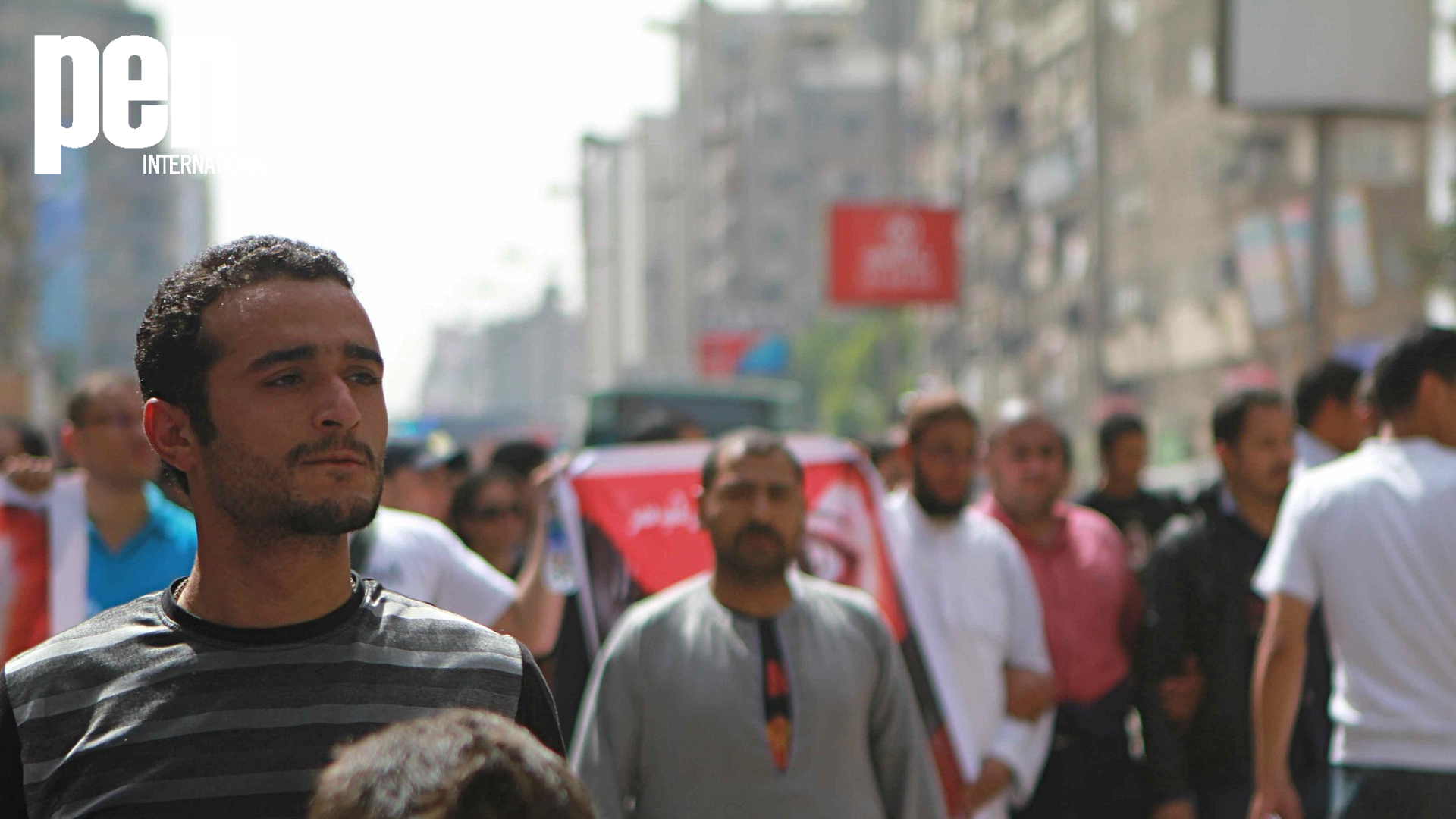
Image Credit: Sarah Carr/ WikkiCommons
‘The relentless persecution of Egyptian poet Ahmed Douma unveils the true extent of the Egyptian authorities' efforts to silence critical voices. Intimidating critics by weaponising the justice system against them every time they write a simple post on social media signals profound insecurity within the Egyptian authorities. Governments should encourage and protect people’s rights to criticise, question, and hold those in power accountable, for without freedom of expression, societies wither rather than flourish and progress.’ Burhan Sonmez, President of PEN International.
22 January 2026: PEN International condemns the arrest and brief detention of Egyptian poet and activist Ahmed Douma for his online expression. The Egyptian government must stop weaponising the justice system to intimidate and silence critics and end its vicious assault on freedom of expression in the country.
Since Douma was released in August 2023 after over a decade in prison, PEN International has recorded at least five open investigations into Douma over his writings and online commentary, in which he faced identical charges and was forced to pay punitive bail fees exceeding EGP 230,000 (approximately USD 4,850). We call for all charges against Ahmed Douma to be dropped, his travel ban to be lifted, and for all his personal belongings, including his writings, to be returned without delay.
On Monday, 19 January 2026, Security agents arrested Egyptian poet and activist Ahmed Douma at his home in Cairo without disclosing the reason for his arrest and took him to an unknown location. The following day, Douma was interrogated by the Supreme State Security Persecution (SSSP) concerning charges of ‘disseminating false news inside and outside the country’ in relation to his online posts about the alleged assault of imprisoned activist Mohamed Adel. According to his family, Douma was handcuffed and blindfolded for almost 12 hours before he was interrogated. During his arrest, security agents confiscated many of his electronic devices, including two mobile phones, a laptop, an iPad, a camera, a hard disk and flash drives. The seized devices contained archives of Douma’s writings, including those written in prison, and drafts of ongoing writing projects, including poetry and short story collections. The SSSP ordered his release on the same day following a lengthy interrogation into his online commentary on bail of EGP 100,000 (approximately USD 2,120).
Despite receiving a presidential pardon in 2023 after being subjected to over a decade in prison, which was deemed arbitrary by the UN Working Group on Arbitrary Detention (WGAD), the Egyptian authorities have continued to intimidate and threaten Douma in an effort to silence him. PEN International has documented a series of intimidating tactics, threats, and physical attacks designed to silence him and discourage any challenge to the government’s narrative. He was repeatedly summoned for investigations and faced similar charges in five separate cases related to his writings since 2024.
In July 2024, Douma faced an online smear campaign after pro-government religious figures deemed parts of his 2021 poetry collection Curly as being an act of ‘blasphemy.’ On 5 October, the Egyptian Public Prosecutor opened an investigation into complaints against Douma, accusing him of writing ‘blasphemous phrases’ in his poetry collection. On 15 October, Douma was physically assaulted by three individuals in plain clothes in an apparent targeted attack. On 10 November, the SSSP released Douma on bail of EGP 20,000 (approximately USD 420) after an eight-hour investigation concerning statements he made on social media about the MV Kathrin, a cargo ship previously linked to transporting weapons to Israel, docking at Egypt’s Port of Alexandria. He was not allowed to receive a copy of the case file or details about the complaint that spurred the investigation.
In April 2025, Douma was charged with ‘disseminating false news inside and outside the country’ and released on EGP 10,000 (approximately USD 210) bail, in relation to his online posts. Similarly, in July, the SSSP charged him with ‘disseminating false news undermining state prestige’ in relation to his commentaries on different issues, including deadly road traffic accidents, fees on humanitarian aid to Gaza, criticism of pro-government media figures, and for sharing a cover of the Arabic translation of Juan José Millás’ novel Tonto, muerto, bastardo e invisible. He was released on bail of EGP 50,000 (approximately USD 1055). Again in September 2025, the SSSP charged Douma with ‘disseminating false news’ in a new case concerning a series of online posts about his experience in Egyptian prisons. He was later released on bail of EGP 50,000 (approximately USD 1055).
In December 2025, Douma obtained a passport for the first time in over a decade. However, he was prevented from boarding a flight to Lebanon by security officials at Cairo International Airport, who cited a travel ban without giving any details. Douma said he was not aware of any travel bans against him.
Background
Since President al-Sisi seized power in 2014, the country's human rights situation has continually deteriorated. However, since he decided to run for a second term in 2018, the country has slipped into an unprecedented human rights crisis. Egyptian authorities continue to systematically punish any public or perceived dissent and severely repress the rights to peaceful assembly, association and freedom of expression. Scores of journalists, human rights defenders, activists and bloggers have been arbitrarily arrested, detained for prolonged periods without trial, and faced trumped-up charges solely in relation to their work or critical views.
For more information, please contact Mina Thabet, Head of the MENA Region, PEN International: [email protected]
For media queries, please contact Sabrina Tucci, Head of Communications and Campaigns, PEN International: [email protected]