
PEACE IS A VERB; PEACE IS A MUST; PEACE NOW! A statement by the Writers for Peace Committee
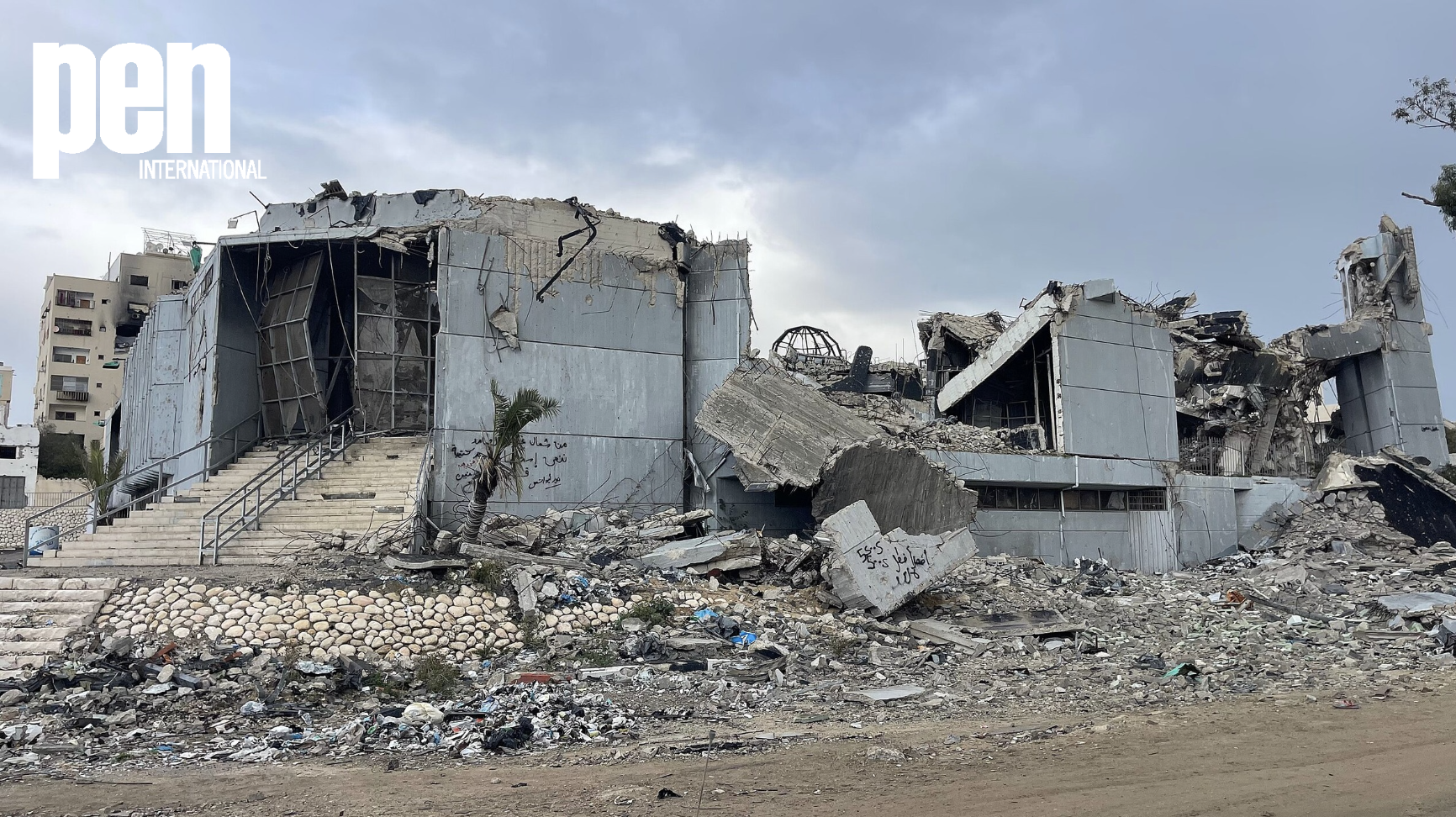
Image Credit : Jaber Jehad Badwan via Wikkicommons
A statement by the Writers for Peace Committee of PEN International for Human Rights Day 2025
10 December 2025: Every year on 10 December, the world marks Human Rights Day, commemorating the adoption of the Universal Declaration of Human Rights in 1948. Seventy-seven years later, that promise is frayed but not broken. As we approach the end of 2025, more than sixty wars and armed conflicts are raging across the globe, driving millions from their homes, eroding the rule of law, and normalising a reality in which mass atrocities are livestreamed, archived and forgotten in the same digital gesture.
We, the Writers for Peace Committee of PEN International, speak from and to this world.
We speak against the deliberate targeting of civilians, the bombing of schools and hospitals, and the use of starvation and siege as weapons of war. We speak against ethnic cleansing and genocidal violence; against the criminalisation of dissent; against the persecution, imprisonment and murder of writers, journalists and artists who dare to testify. We speak against gender-based violence and inequality, and all forms of marginalisation based on race, religion, language, disability, or sexual orientation, and gender identity.
We speak also against the quieter architectures of harm:
against the weaponisation of poverty and debt;
against extractive economic policies that keep whole regions precarious;
against digital platforms that amplify hatred and lies faster than a poem can travel;
against corporate and political actors who treat truth as a negotiable commodity.
Yet we insist: this is not fate.
Human beings created these systems; human beings can unmake and remake them.
We believe that humanity still has the power to resist the repetition of its own violent history. We stand together with the next generation to imagine – and to enact – a world that recognises and defends human rights for all.
We know. But how can we act?
As writers, we work with the most fragile and the most enduring material: language. We search for words, for stories, for poetry and prose that keep alive the truth that every human life is singular and irreplaceable. We know that literature alone cannot stop a bomb, but it can refuse the vocabulary that makes bombing thinkable. It can slow down the speed of hatred. It can build, line by line, a memory that resists erasure.
And yet our words are often drowned out by the noise of propaganda and polarisation. In the words of Margaret Atwood, “War is what happens when language fails.” When vocabulary collapses into slogans, when people are reduced to categories, when nuance is denounced as betrayal, the road to violence becomes frighteningly short.
Are we going to give in to apathy rather than confronting it with empathy?
No, we will not.
We reaffirm our commitment to defend those who are persecuted for their words, their silences and their refusals. We reaffirm the right to freedom of expression and the right to receive information – rights that are not luxuries of peace, but essential conditions for any genuine peace to exist.
However, on this Human Rights Day 2025, we insist: words must be joined by deeds.
We therefore call on governments and international institutions:
to immediately cease the targeting of civilians and civilian infrastructure, and to uphold without exception the principles of international humanitarian law;
to ensure the safe and unimpeded delivery of humanitarian aid to civilians in need;
to guarantee the protection of writers, journalists, artists, and cultural workers in all war and conflict zones, including through emergency visas, safe corridors, and shelter programmes;
to end the use of starvation, forced displacement and collective punishment as tools of war and political control;
to support independent courts and mechanisms of international justice capable of investigating and prosecuting war crimes, crimes against humanity and genocide, regardless of the identity or political alliances of the perpetrators;
to allow and protect local and international journalists to safely report from conflict and war zones, and to adequately fund independent media, public broadcasting and cultural institutions, which are essential defences against authoritarianism and disinformation.
We call on technology companies and media platforms:
to stop profiting from the algorithmic amplification of hate speech, incitement to violence, and disinformation, and to subject their systems to independent democratic oversight;
to protect users who are at particular risk, including writers, journalists, human rights defenders, and minority communities, from targeted harassment, coordinated disinformation campaigns, and digital surveillance.
We call on the arms industry and the states that license it:
to recognise that every contract signed in comfort reverberates in the ruins of cities and villages, and
to move towards binding international limits on the trade and export of weapons to parties involved in grave human rights violations.
We call on our fellow writers, readers, and citizens everywhere:
to refuse the language of dehumanisation,
to amplify silenced voices,
to support organisations that protect those at risk,
to turn private despair into public solidarity.
Peace is not only the absence of conflict written into a treaty and filed away.
It is a daily practice of justice, accountability, memory, and imagination.
As Slovenian poet Boris A. Novak writes, “Freedom is a verb.”
We paraphrase: Peace is a verb. It is something we do, or it does not exist.
On this Human Rights Day 2025, we commit ourselves once again:
to watch and to witness,
to speak and to listen,
to remember and to resist.
Peace is a verb.
Peace is a must.
Peace now.
PEN International Writers for Peace Committee