
Myanmar: Five years after the coup, expression remains under attack
“Last month, the Myanmar military attempted to legitimise its rule through a carefully orchestrated electoral process. This so-called election was nothing more than an effort to impose a veneer of legality over the junta's authoritarian grip on power. By dismantling all four pillars of democracy, the military has stripped the Myanmar people of their basic rights and extinguished any genuine chance for peace.” — Ma Thida, Chair of PEN International’s Writers in Prison Committee
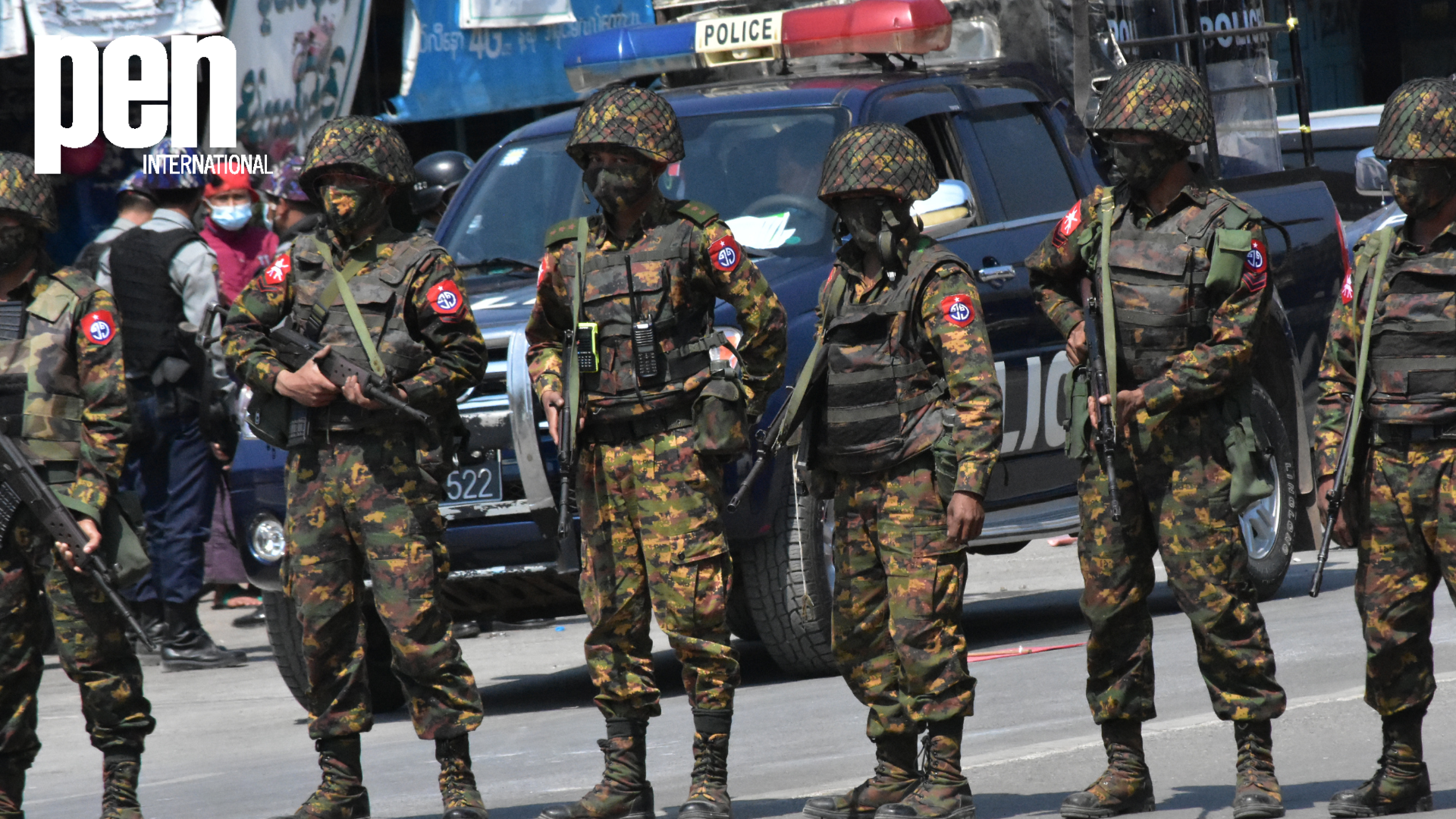
2 February 2026: Five years after Myanmar’s military seized power in a coup on 1 February 2021, the country remains trapped in a deepening humanitarian and human rights catastrophe.
The junta has ruled through terror, killing civilians, dismantling democratic institutions, and systematically silencing those who dare to speak out. PEN International stands in solidarity with Myanmar’s writers, poets, and journalists, who continue to resist repression at extraordinary personal risk.
Since the coup, the military has killed more than 6,800 people and arbitrarily detained over 22,000 others. At least 3.6 million people have been internally displaced, while more than one-third of the population now requires humanitarian assistance. These figures only begin to convey the scale of devastation inflicted by the regime.
Attacks on freedom of expression lie at the heart of the junta’s strategy of control. Over the past five years, dozens of writers, journalists, and artists have been imprisoned without due process. Among them is writer and activist Wai Moe Naing, who is serving a combined sentence of 74 years in prison. Others have died as a result of torture and appalling detention conditions. One such case is documentary filmmaker Pe Maung Sein, who was released only when gravely ill and died days later from the mistreatment he endured in prison.
The junta has weaponised the law to criminalise dissent. Section 505(a) of the criminal code is routinely used to punish even the most minimal expressions of opposition. A black social media profile picture, a shared news article, or a critical comment can result in arrest, torture, and years behind bars. New legislation, including the Cybersecurity Law, has further entrenched military control over online spaces. Enacted in January 2025, the law bans VPN use and criminalises online expression, placing ordinary people under constant threat.
Internet shutdowns are among the military’s most pervasive tools of repression. Myanmar is one of the world’s worst perpetrators of connectivity blackouts, which are frequently imposed alongside airstrikes and ground assaults. These shutdowns conceal atrocities, obstruct humanitarian assistance, and endanger lives.
The deadly consequences of this information blackout were laid bare during the devastating earthquake that struck Myanmar in March 2025. Thousands were killed and entire communities were destroyed. Even as survivors searched for loved ones under the rubble, the junta restricted internet access, choking off the flow of potentially life-saving information.
Myanmar’s writers and journalists are also increasingly being forced into exile. Many have fled to neighbouring countries, including Thailand, where they live precariously. Others remain inside Myanmar, risking detention amid intensified house-to-house searches linked to the junta’s policy of forced conscription.
One writer forced into hiding was the former president of PEN Myanmar, Nyein Chan, known by his pen name Nyi Pu Lay. Following the coup, the junta issued a warrant for his arrest under Section 505(a). Subjected to harsh living conditions and denied access to adequate medical care due to the risk of arrest, Nyi Pu Lay died of a heart attack on 21 June 2023.
The plight of the Rohingya community remains one of Myanmar’s gravest human rights failures. Rohingya civilians face forced conscription, atrocities, and indiscriminate violence. Already subjected to years of genocidal attacks and mass displacement, they are once again caught between warring forces in Rakhine State. Rohingya poets and writers—many of whom are living in exile or displacement camps—continue to bear witness to a crisis the world must not ignore.
In January 2026, as the military pressed ahead with a tightly controlled, multi-phase election, the junta claimed it was restoring democracy. In reality, the process was yet another attempt to entrench military rule and mislead the international community.
At the core of the election lay an assault on free expression and political participation. Ahead of the vote, the junta enacted a sweeping new election law criminalising any criticism of the election process or the legitimacy of the polls. More than 200 people have already been charged. The law is not designed to protect electoral integrity. Instead, its purpose is to silence dissent, intimidate voters, and eliminate alternative narratives.
Nevertheless, five years on, the people of Myanmar continue to show extraordinary courage. Writers, journalists, and artists persist in documenting abuses and imagining a different future.
PEN International calls for an immediate end to the violence, the unconditional release of all those imprisoned for their peaceful expression, and the lifting of all restrictions on independent media and internet access. The organisation urges the international community to reject the junta’s sham electoral process, ensure accountability for war crimes and crimes against humanity, and provide sustained support to Myanmar’s writers and journalists, both inside the country and in exile.
Note to editors:
For further details, contact Michael Altman Rosen-Lupu, Head of Asia/Pacific Region at PEN International: [email protected]
For media queries, please contact Sabrina Tucci, Head of Communications and Campaigns at PEN International: [email protected]