
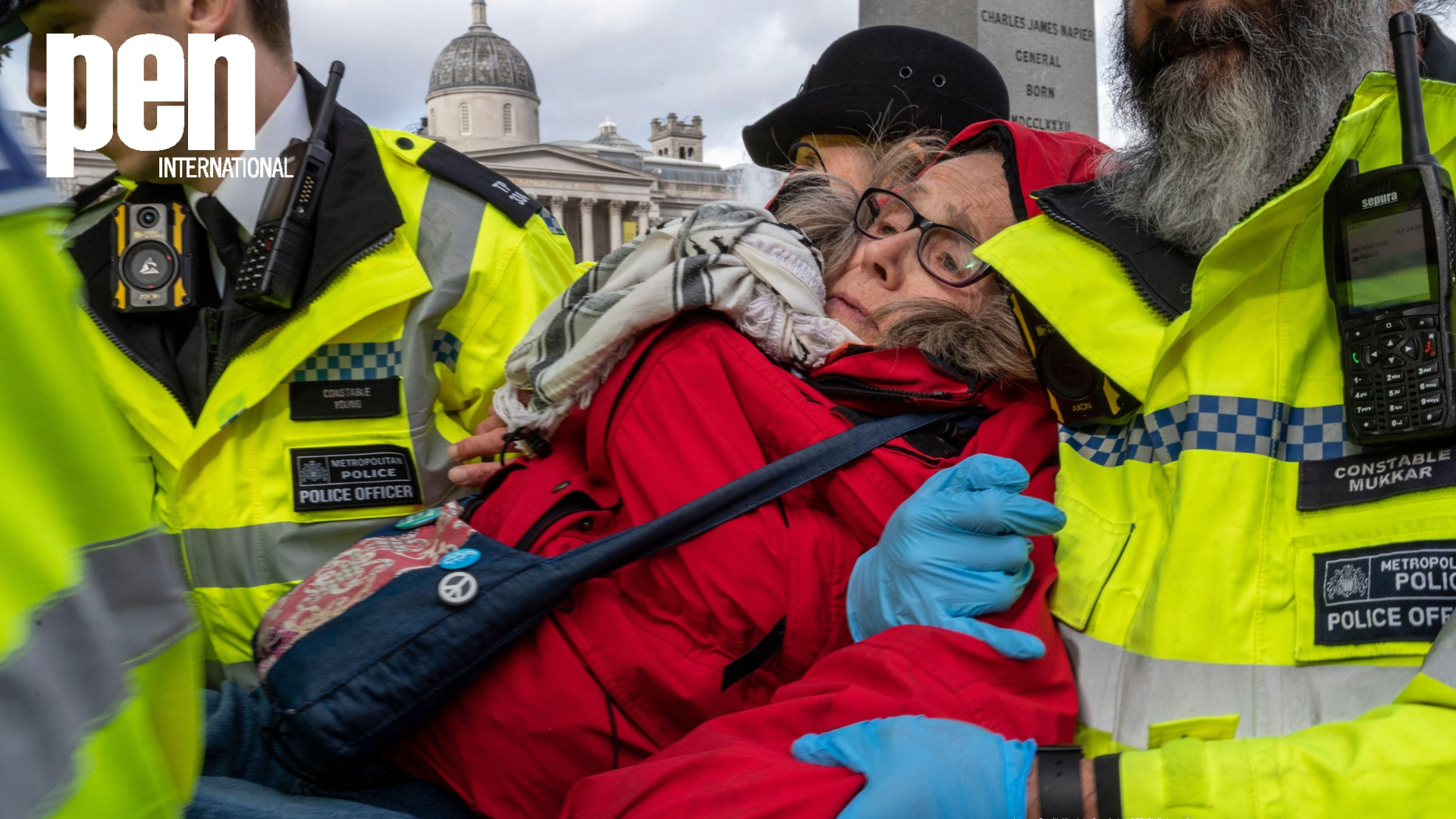
Image Credit: Maggie Sully/Alamy
4 November 2026: English PEN and PEN International have been granted permission by the UK Supreme Court to intervene in the appeal against the proscription of Palestine Action under the Terrorism Act 2000. The hearing is scheduled to take place on 4 and 5 November 2026.
The appeal, R (Ammori) v Secretary of State for the Home Department (UKSC/2026/0099), is brought by Huda Ammori, a co-founder of Palestine Action, against the judgment of the Court of Appeal of 15 June 2026, which overturned the ruling of the High Court in February 2026 that the proscription was an unlawful interference with the rights to freedom of expression and assembly protected by Articles 10 and 11 of the European Convention on Human Rights. The single question before the Supreme Court is whether the proscription is compatible with those Articles.
PEN’s written case focuses on the impact of proscription on the right to freedom of expression of journalists, writers, academics and artists, whether they report on a proscribed organisation, comment on it, study it or respond to it creatively, including in the debate about whether it should be proscribed or de-proscribed. Article 10 of the European Convention on Human Rights protects both their freedom to report on, discuss and depict a proscribed organisation and the right of the public to receive their work.
The written case argues that writing, speaking and circulating information about a proscribed organisation, and the right of the public to receive that expression, were left out of account when the proportionality of proscription was assessed. It invites the Court to take them into account in deciding whether the proscription is compatible with Articles 10 and 11.
“Proscribing an organisation must not make it untouchable as a subject of public discussion. Writers, journalists, teachers and researchers must be able to examine events, explore competing perspectives and scrutinise the actions of those in power without fear that doing so could expose them to criminal liability. When that freedom is constrained, the loss extends far beyond the individuals who self-censor: it limits what society can question, learn and understand. Through our intervention, we ask the Court to consider these wider consequences for public debate and the free exchange of ideas.” Romana Cacchioli, Executive Director of PEN International
“Proscription was a step we urged the Government not to take, and what has followed has shown how far its consequences reach. Our concern is for the writers, journalists, academics and artists whose work requires them to be free to examine a proscribed organisation and for the public who depend on that work. We welcome the opportunity to intervene in the case and are hugely grateful to the legal team working with us on the intervention for their invaluable support.” Daniel Gorman, Director of English PEN
On 30 June 2025, English PEN and PEN International – along with Scottish PEN and Wales PEN Cymru – shared serious concerns at the UK government’s proposal to proscribe Palestine Action, urging the authorities to reconsider this step and to ensure full respect for the rights to freedom of expression, association and peaceful assembly. In the 12 months to June 2026, the first year of the proscription, there were 3,867 arrests for terrorism-related activity in Great Britain, up from 234 the year before, an increase of 1,553%. The Home Office records 3,630 of those arrests (94%) as linked to supporting Palestine Action.
English PEN and PEN International are represented by Professor Can Yeğinsu, of 3 Verulam Buildings, and Aislinn Kelly-Lyth, of Blackstone Chambers. They are instructed by Michael Oswald of Bhatt Murphy Solicitors.
You can read PEN’s written case here.
Notes to editors:
For media queries, please contact:
Sim Eldem, Deputy Director, English PEN, [email protected]
Sabrina Tucci, Head of Communications and Campaigns, PEN International, [email protected]