
PEN International Writers in Prison Committee
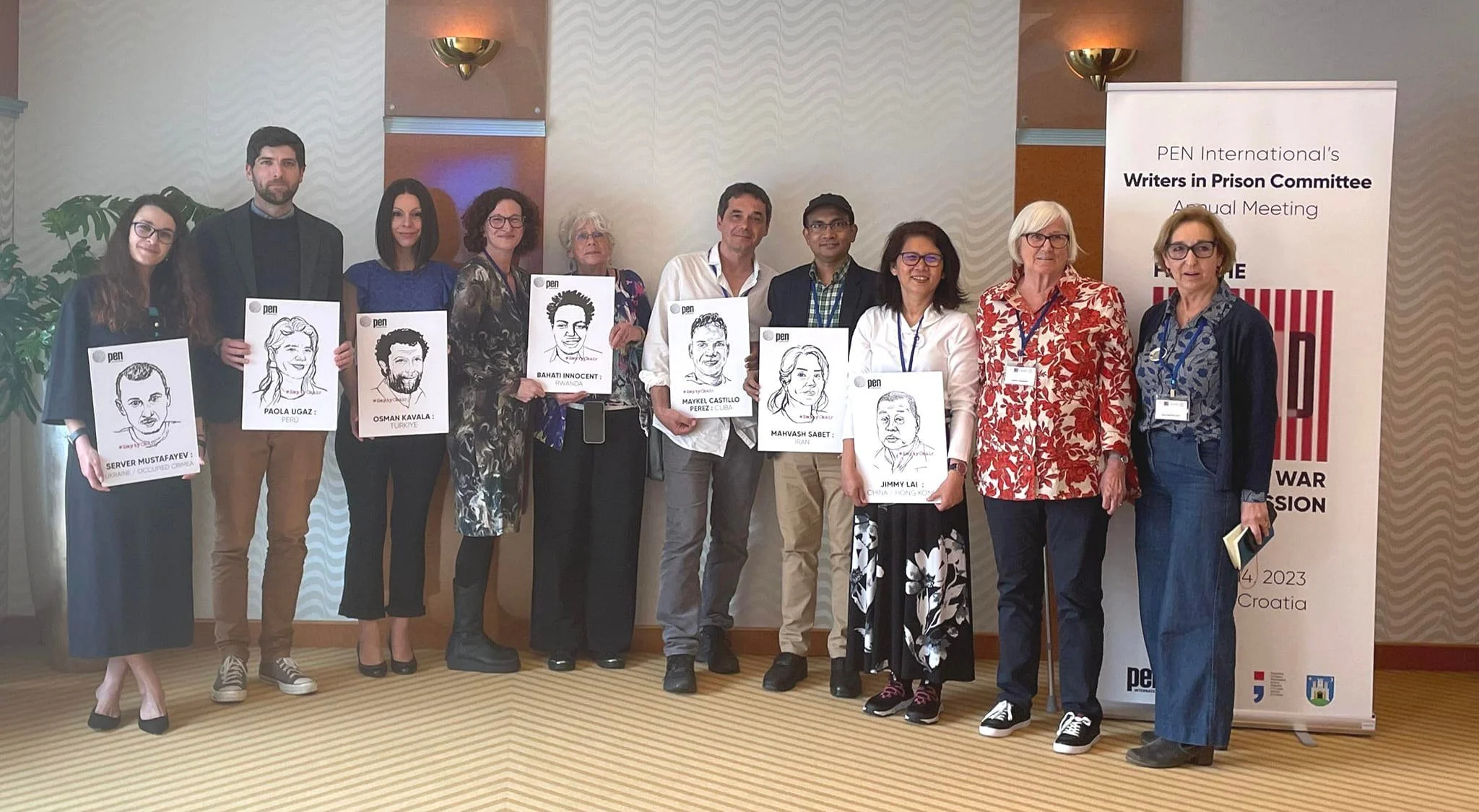
Image credit: PEN International. Taken at an Annual Committee Meeting in Croatia, 2023
“When a writer is imprisoned for their words, our collective freedom is diminished. The Writers in Prison Committee stands with those who risk everything to defend their right to write, publish, read, and think freely.” Ma Thida, Chair of PEN International Writers in Prison Committee
The Writers in Prison Committee (WiPC) is central to PEN International’s mission to defend freedom of expression worldwide. It monitors attacks on writers and mobilises PEN’s global network to support those imprisoned, persecuted, or threatened for their work by governments, armed groups, or other powerful actors.
Defending writers across decades
The WiPC was formally established at the PEN International Congress in Rio de Janeiro in 1960 to coordinate PEN’s efforts to defend writers worldwide through research, advocacy and campaigning. Early discussions addressed a wide range of threats, from imprisoned poets and novelists to authors censored for their political or cultural expression.
In the 1970s, PEN Centres began selecting writers from the Case List as Honorary Members, pledging to campaign on their behalf until their release. This remains a cornerstone of PEN’s advocacy, with Centres raising awareness of honorary writers, writing to authorities, engaging the public, and supporting families and legal representatives.
Campaigns and solidarity
Central to the WiPC’s work is its Case List, documenting writers who have suffered violations from harassment and censorship to imprisonment, disappearance, and murder. Initially compiled from information gathered by PEN members and exiled writers, over the years PEN International Case List has become a key tool for monitoring global trends and guiding advocacy campaigns.
The Committee’s work is also marked by the Day of the Imprisoned Writer, held annually on 15 November. First proposed by former PEN President Arthur Miller the late 1960s, the campaign was officially launched in 1981 by the WiPC. Today, it brings together PEN Centres across more than 100 countries for actions such as advocacy letters to governments, petitions, readings, debates, performances, and letter-writing supporting writers at risk. Activities often focus on a few emblematic cases representing the broader struggle for freedom of expression.
Beyond individual cases, the WiPC addresses wider threats. Its advocacy highlights the persistent problem of impunity, book bans, the effects of war and conflict on freedom of expression, the misuse of criminal defamation laws, the use of anti-terror legislation to restrict free expression, and attacks on writers accused of blasphemy or religious offence, among others.
International advocacy
The WiPC works closely with international bodies to strengthen protections. Through PEN International’s consultative status with UNESCO and engagement with the United Nations human rights system, it raises cases before governments and international institutions.
PEN representatives regularly participate in discussions at the United Nations Human Rights Council in Geneva, submit statements on country situations, and advise UN Special Rapporteurs on freedom of expression and cultural rights. The Committee collaborates with regional organisations including the Organisation for Security and Cooperation in Europe, the Organisation of American States, and the African Commission on Human and Peoples’ Rights.
Protection and refuge
Providing practical support to writers under threat has long been part of PEN International’s mission. In the interwar years, the organisation helped writers fleeing Nazi Germany, and support continued during the Cold War for those escaping authoritarian regimes.
In 2005, Norwegian PEN led the creation of the International Cities of Refuge Network (ICORN), offering temporary residencies to persecuted writers. The WiPC helped establish a system for assessing writers’ applications to ICORN residencies and continues to provide expert evaluations. Over time, additional PEN Centres joined the network, helping create cities of refuge that have offered safety to hundreds of writers in Europe and beyond.
A continuing struggle
Today, writers around the world continue to face imprisonment, harassment, and violence for expressing critical views. Authors, poets, publishers, bloggers, and journalists remain at risk simply for exercising their right to free expression.
Through monitoring, research, advocacy, and international campaigning, the WiPC remains central to PEN International’s mission. By mobilising solidarity across borders and defending writers at risk, it affirms a fundamental principle: that freedom to write and speak openly is essential to literature, democracy, and human dignity.
Note to editors:
For media queries, contact Sabrina Tucci, Head of Communications and Campaigns at PEN International: [email protected]
To find out more, contact Ma Thida, Chair of the WiPC: [email protected]