
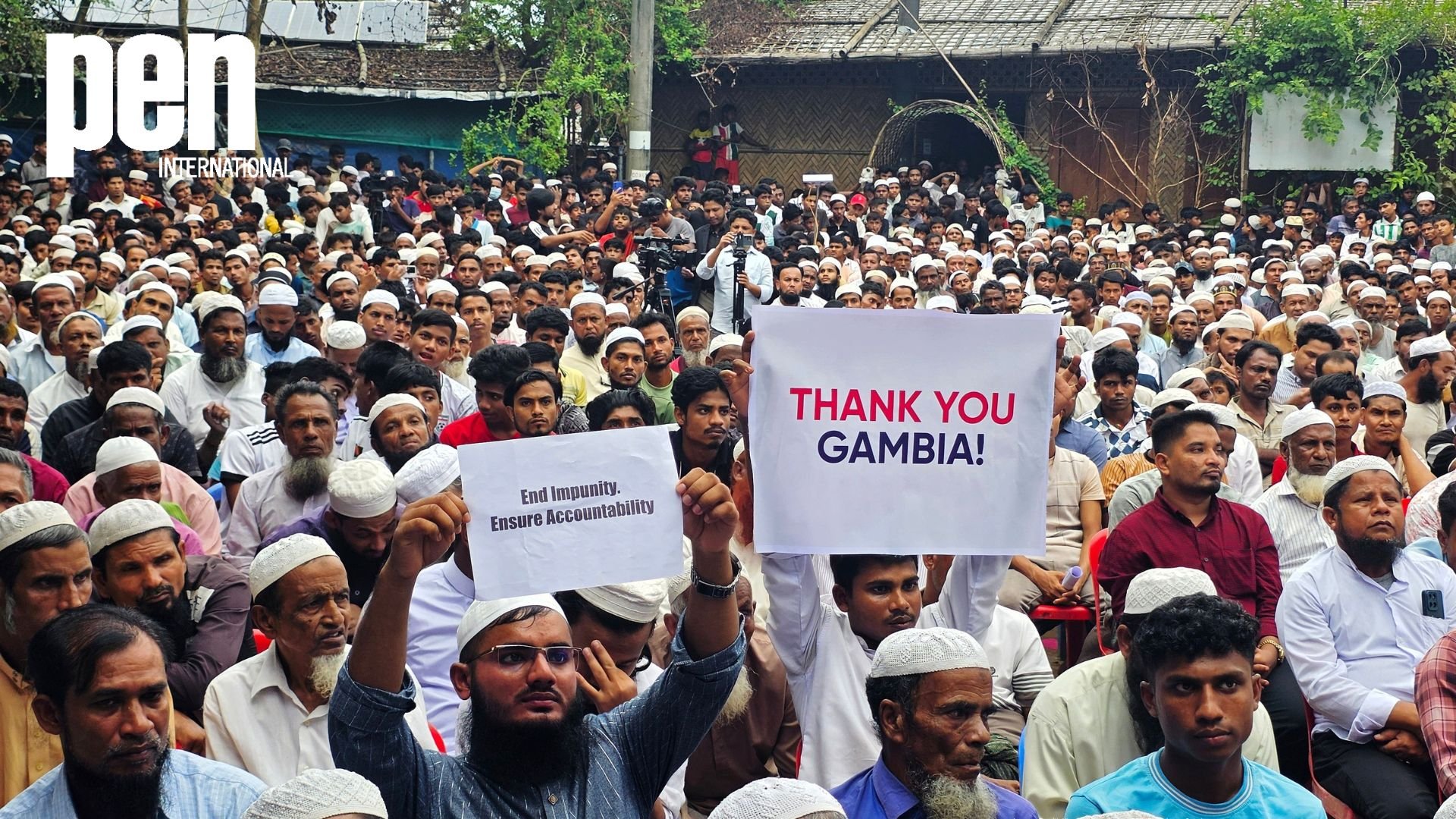
Image Credit: YASSIN ABDUMONAB/EPA/ShutterStock
‘This landmark moment must mark the beginning of real accountability for the Rohingya community. The military-controlled government must comply with the ICJ’s orders, and the international community must now support the judgment and work together to hold those responsible for the genocide to account. Only by breaking the cycle of violence and impunity imposed on Myanmar by its military can we begin to create the conditions necessary for the Rohingya to live in peace and safety’, said Romana Cacchioli, Executive Director of PEN International.
'This judgment can help the Rohingya people secure justice, protection and safety wherever they are now, until the day they can safely return to their homes. It must be a decisive turning point towards holding Min Aung Hlaing and the Myanmar military leadership to account for their role in genocide, crimes against humanity, war crimes and other atrocities committed against civilians across Myanmar, whether targeted for their ethnicity, religion, or simply because they refuse to submit to military rule. Justice must reach all victims, without discrimination. No one should be above the law', said Ma Thida, Chair of PEN International's Writers in Prison Committee.
20 November 2026: Yesterday, the International Court of Justice (ICJ) delivered its judgment in a case brought against the state of Myanmar for violations of the 1948 Convention on the Prevention and Punishment of the Crime of Genocide (Genocide Convention). In its ruling, the ICJ found that the state of Myanmar committed genocide.
The ICJ’s judgment, the first time it has found a state responsible for committing genocide under the Convention, is a significant milestone for international law and marks a turning point in the pursuit of accountability for the atrocities committed against Myanmar’s Rohingya community.
The case was initially brought before the ICJ by the state of The Gambia on 11 November 2019. In addition to finding that Myanmar committed genocide, the Court found that Myanmar failed to prevent and punish genocide, and ordered it to provide reparations, including facilitating the safe and voluntary return of displaced Rohingya, and to report back to the Court within two years.
When reading the judgment, the ICJ’s president, Yuji Iwasawa, stated that Myanmar's security forces ‘killed thousands of Rohingya civilians, perpetrated widespread acts of sexual violence, as well as acts of extreme violence against children, and attacked fleeing Rohingya as they sought to flee in large numbers’, and noted that ‘the separation of sexes and killing of men in multiple villages during the clearance operations, as well as the brutal murder of infants, also supports the inference that Myanmar's security forces acted with the intent to prevent births among the group’.
While the ICJ case focuses responsibility on the State of Myanmar, it follows previous findings by the UN’s Independent International Fact-Finding Mission on Myanmar (IIFFMM), which in 2018 called for the investigation and prosecution of Myanmar’s then Commander-in-Chief, Senior General Min Aung Hlaing, and his top military leaders for genocide, crimes against humanity and war crimes. In November 2024, an application for an arrest warrant against Min Aung Hlaing was filed by the Prosecutor of the International Criminal Court (ICC), following its own investigation into violence perpetrated against Myanmar’s Rohingya community. The application remains pending, while Min Aung Hlaing has since been installed as president by a military-dominated parliament following a sham election.
The Rohingya have been subjected to decades of state-sponsored discrimination and disenfranchisement, including the denial of citizenship under Myanmar’s 1982 Citizenship Law. Following attacks on police posts by the Arakan Rohingya Salvation Army in October 2016, Myanmar’s military and security forces carried out so-called ‘clearance operations’ against the Rohingya civilian population in Myanmar’s northern Rakhine state. In 2017, they razed hundreds of Rohingya villages and committed mass atrocities against Rohingya civilians, including reports of pervasive acts of sexual violence, torture, and the killing of an estimated 10,000 Rohingya men, women and children, according to the ICJ’s findings.
The ICJ itself recognised that decades of discriminatory laws and a military-sponsored campaign of hate speech created an atmosphere conducive to the violence. That campaign, promoted by Myanmar state officials, politicians, military and religious leaders, sought to stoke ethno-religious division by dehumanising Myanmar’s Rohingya population. A report published in 2024 by the IIFFMM’s successor body, the United Nations Independent Investigative Mechanism for Myanmar (IIMM), which examined material posted on Facebook over the period when many of the clearance operations took place in 2017, found that the Myanmar military ‘spread material designed to instil fear and hatred of the Rohingya minority’ and that the ‘campaign of hatred was ongoing at the very time that many Rohingya villages were burned and while thousands of Rohingya men, women and children were beaten, sexually assaulted and/or killed’.
Over 700,000 Rohingya were forced to flee the genocide to Cox’s Bazar in neighbouring Bangladesh, which is now home to approximately 1.2 million displaced Rohingya living in what has become the world’s largest refugee settlement. Among those displaced and living in dire conditions are Rohingya poets, writers and others who have continued to use their writing to express their collective trauma and resilience in the face of an ongoing humanitarian crisis.
For Rohingya refugees, this week’s ruling is a source of hope that those responsible for perpetrating the genocide against their community may be held to account, and a step towards repatriation to their homeland. However, with Myanmar engulfed in a protracted civil war since the military’s seizure of power in February 2021, including intense conflict between the military-controlled government and the Arakan Army, an ethnic armed organisation, which has resulted in ongoing atrocities being committed by both parties against the Rohingya, the ability for those displaced to return to their homeland and live in peace remains a distant prospect.
The international community must act on this ruling and do everything in its power to uphold this judgment by supporting efforts to hold those responsible to account, and by supporting those displaced by genocide by creating the conditions necessary for facilitating the safe, voluntary, and dignified return of displaced Rohingya to their homeland.
Note to editors:
For further details contact Ross Holder, Head of Research, Policy and Advocacy at PEN International: [email protected].
For media queries, please contact Sabrina Tucci, Head of Communications and Campaigns at PEN International: [email protected].