PEN International Translation and Linguistic Rights Committee
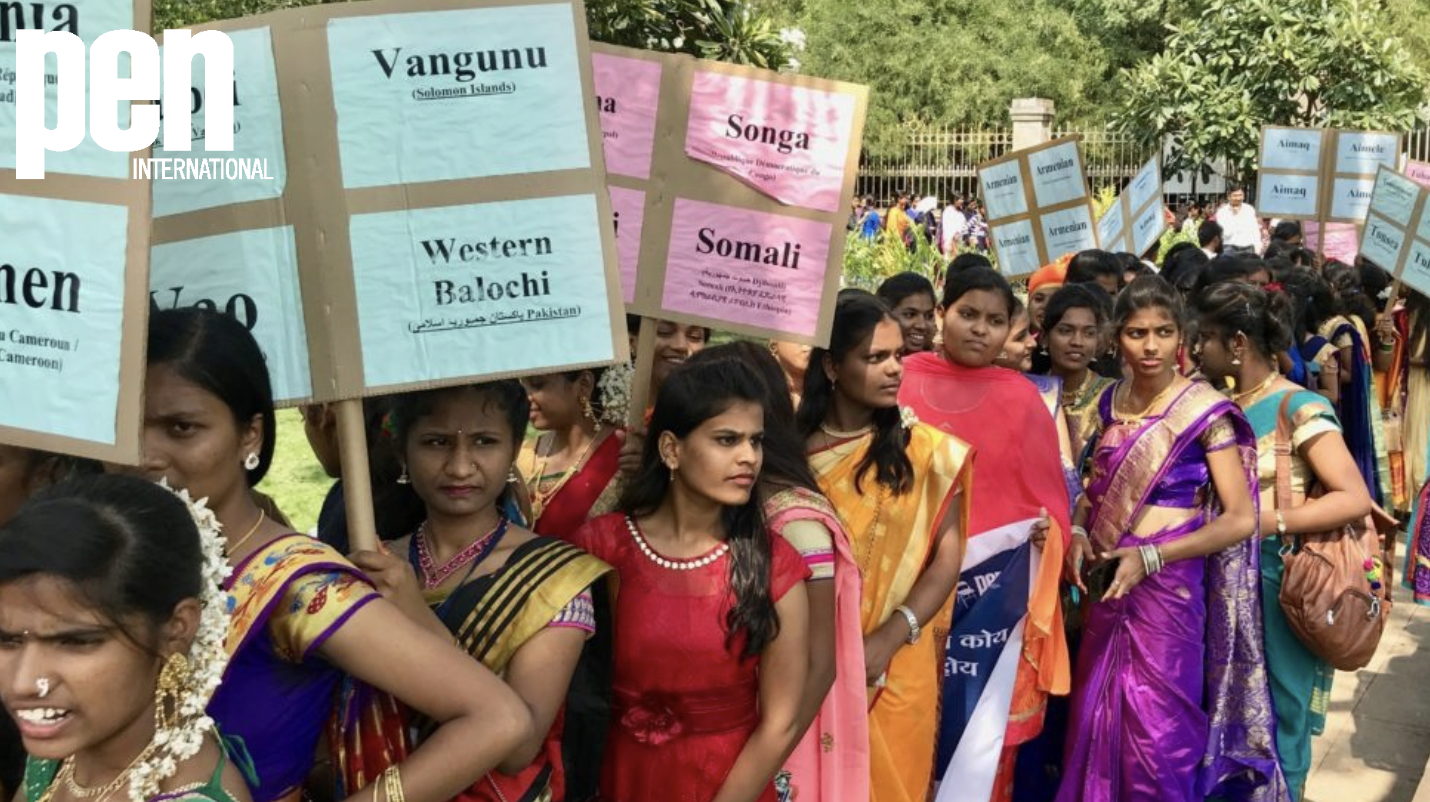
Image credit: Carles Torner. Students take part in the Bhasha Wari procession during the 84th PEN International Congress in Pune (2018), celebrating the words Truth, Freedom, Diversity across 6,000 languages.
“At a time when so many voices risk being silenced, our Committee works to ensure that every language has the space to thrive. Protecting linguistic rights is not only about preserving heritage — it is about safeguarding dignity, diversity, and the freedom to imagine in one’s own words.” Urtzi Urrutikoetxea, Chair of PEN International Translation and Linguistic Rights Committee
In a world where thousands of languages are at risk, defending linguistic rights has never been more urgent. PEN International Translation and Linguistic Rights Committee (TLCR) stands at the centre of one of the most important struggles of our time: ensuring that all languages — and the people who speak, write, and dream in them — can flourish.
The Committee’s mission is rooted in the belief that translation is more than a literary act; it is an act of solidarity. When a language is marginalised, its stories and people risk disappearing. Translation offers a bridge, carrying those voices into new spaces, widening their reach.
A history of championing translation
Although the TLCR was officially created in 1978 during PEN International 43rd Congress in Stockholm, its commitment to translation began much earlier. As far back as 1928, PEN collaborated with the International Institute of Intellectual Co-operation, a League of Nations body, to promote translations across borders. PEN Centres identified works deserving translation, which the Institute then shared with publishers worldwide. A Geneva meeting in July 1928, attended by figures such as John Galsworthy and Salvador de Madariaga, formally approved the arrangement.
The creation of the TLCR
By 1978, this vision had grown into a formal structure dedicated to translation. That year, under the global presidency of Mario Vargas Llosa, Swedish PEN used the Stockholm Congress to draw attention to the essential role of translators. Per Wästberg, then president of Swedish PEN, put together a coalition of PEN Centres to broaden access to world literature. Originally known as the Programme and Translation Committee, its first aim was simple yet radical: to champion translation from all literary traditions, especially those with little international presence. The Committee supported anthologies bringing lesser-translated voices into dialogue — for example collaborations between Portuguese and Catalan poets or Macedonian and French poets.
From “small” to “minoritised” languages
One of the Committee’s key contributions has been to challenge the idea of “small languages” and advancing the concept of “minoritised languages” — languages marginalised by political, economic, and cultural forces. During the late 1980s and early 1990s, under the leadership of Portuguese poet Ana Hatherly, the Committee sharpened its focus on cultural rights. With strong support from several PEN Centres, it affirmed that translation cannot be separated from defending linguistic communities. This led to the Committee’s current name: the Translation and Linguistic Rights Committee.
The World Conference on Linguistic Rights
This mission culminated in 1996, when 61 NGOs, 41 PEN Centres, and 40 experts gathered in Barcelona for the World Conference on Linguistic Rights. Organised by the Committee in partnership with the International Escarré Centre for Ethnic Minorities and Nations and with UNESCO’s support, the event aimed to create a global framework to protect linguistic rights.
Over three days, experts, activists, and writers drafted the Universal Declaration of Linguistic Rights (UDLR). Its scientific council, chaired by linguist Isidor Marí, warned that up to 80% of the world’s languages could disappear within the twenty-first century. The Declaration set out principles for linguistic justice and cultural coexistence and was formally approved at the University of Barcelona, with delegates from every continent signing it. UNESCO received the document a month later.
Building on the UDLR
Fifteen years later, the Girona Manifesto (2011) and the Quebec Declaration on Literary Translation and Translators (2015) continued to advance linguistic and translation rights. The Committee has also held meetings outside Europe, including Johannesburg (2016), Bengaluru (2017), and San Cristóbal de las Casas (2019), where the first Indigenous PEN Centre joined the PEN family (PEN Chiapas Pluricultural). The COVID-19 pandemic inspired the launch of the Video-Poem Marathon in Indigenous and Minoritised languages, further supporting their visibility. Since then, more Indigenous writers and their languages are represented, and the anthology Lenguas Vivas, featuring 26 authors in Indigenous languages of Latin America, has become a milestone in PEN International’s history.
A legacy that matters
From its earliest years, the TLCR has defended linguistic diversity, promoted translation, and upheld the rights of communities whose languages are endangered or overlooked. At a time when globalisation threatens to flatten cultures, the Committee reminds us that every language carries its own worldview and that every worldview is essential to humanity.
Note to editors:
For media queries contact Sabrina Tucci, Head of Communications and Campaigns at PEN International
To find out more about the TLCR, read our History of the TLRC