
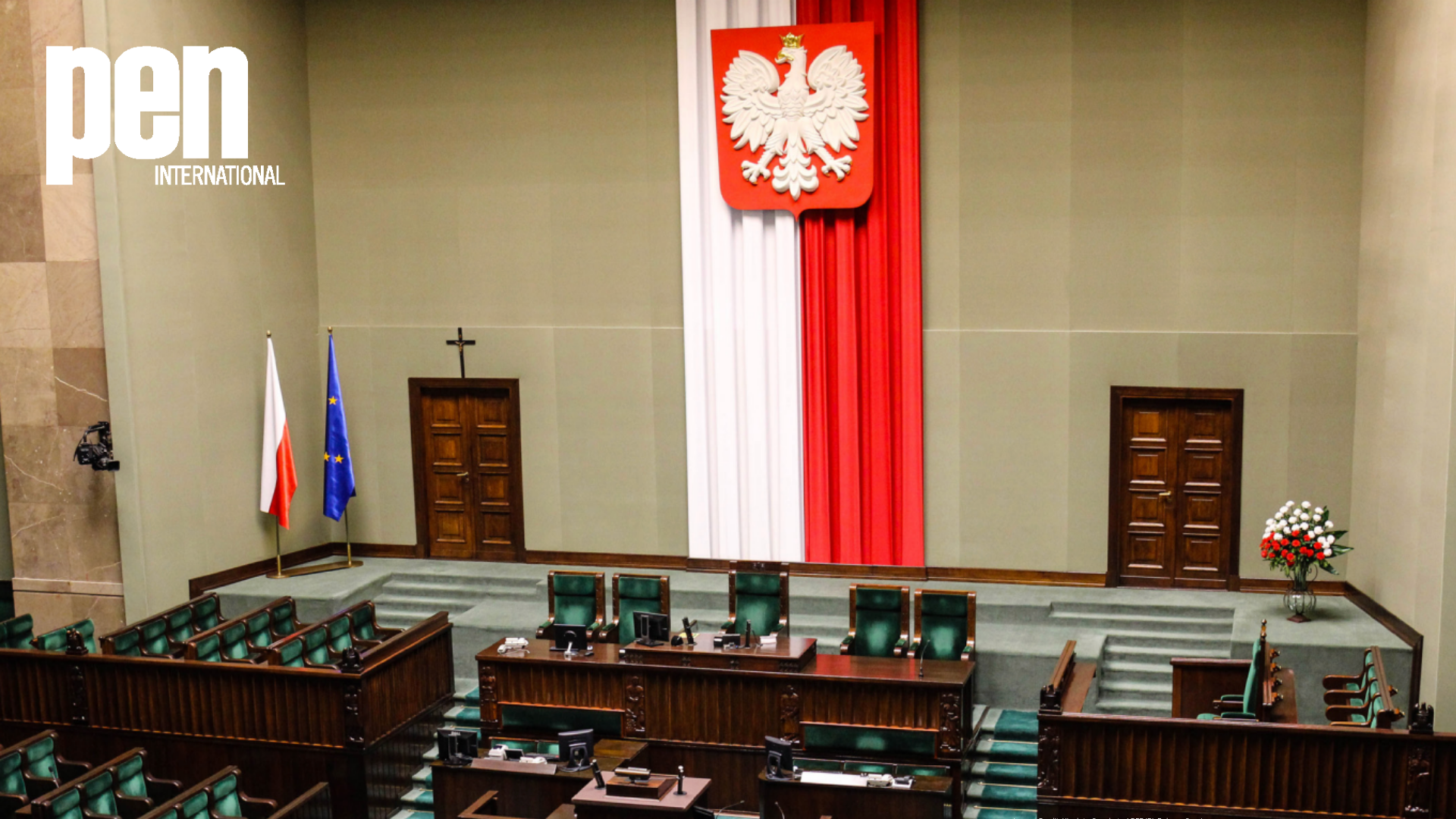
Photo Credit: Katarzyna Uroda/ Shutterstock.
‘For years, SLAPPs have emotionally and financially burdened Poland’s writers and journalists. As we celebrate the passing of the Anti-SLAPP Act, we call for these positive changes to inspire broader reforms in the country, starting with the long-awaited repeal of criminal defamation’, said Ma Thida, Chair of PEN International’s Writers in Prison Committee.
26 June 2026 – PEN International and Polish PEN welcome Poland’s Anti-SLAPP Act, a win for press freedom and protection for writers and journalists against vexatious lawsuits. The organisations call on the Polish authorities to seize on the momentum by decriminalising defamation and repealing other problematic criminal provisions.
On 19 June 2026, Poland’s President Karol Nawrocki signed into law the Act on Special Protection Measures in Civil Proceedings for Persons Participating in Public Debate, also known as the ‘Anti-SLAPP Act’. Strategic lawsuits against public participation – SLAPPs – are abusive lawsuits filed by powerful individuals and companies as a means of silencing critical expression. They typically use long and costly legal procedures, or the threat thereof, to intimidate and harass critics into silence.
As documented in PEN’s report Critical Junctures: Safeguarding the Freedom to Create in Poland, published in October 2025, the past 10 years have witnessed the growing misuse of both criminal and civil laws against writers, journalists, editors and public critics in Poland, in a bid to harass and silence them. Individuals interviewed for the report stressed how SLAPP lawsuits impeded their ability to pursue further journalistic investigations or concentrate on writing new books.
National and international organisations praised several elements of Poland’s Anti-SLAPP Act, including early dismissal mechanisms for vexatious lawsuits, the introduction of security deposits for claimants, and the reversal of the burden of proof on the claimant in SLAPP cases. PEN International and Polish PEN join partners in welcoming Poland’s legislation as one of the strongest anti-SLAPP laws and urging other EU Member States to follow suit.
The campaign for decriminalising defamation has a history stretching over 20 years in Poland. Notably, in April 2024, the then Minister of Justice announced the current administration’s willingness to repeal defamation. Yet as it stands, several provisions in Poland’s Penal Code remain incompatible with international human rights standards, some of which have been misused against members of the literary, journalistic, and activist communities. PEN International and Polish PEN urge the authorities to fulfil their pledge to decriminalise defamation (Article 212 of the Penal Code) and to repeal other criminal law provisions inconsistent with international human rights standards, including those on ‘offending religious feelings’ (Article 196), ‘insulting the President’ (Article 135), ‘insulting public officials or constitutional organs’ (Article 226), and ‘insulting the Polish nation or state symbols’ (Articles 133 and 137).
Additional information
PEN’s report Critical Junctures: Safeguarding the Freedom to Create in Poland, documents the challenges to freedom of expression and cultural rights in the country between 2015 and 2025 while recognising the resilience of writers, journalists and civil society under mounting political pressure, and offering clear recommendations for reform. The report is available in English and Polish here.
Note to editors:
For further details, contact Aurélia Dondo, Head of Europe and Central Asia Region at PEN International: [email protected]
For media queries, please contact Sabrina Tucci, Head of Communications and Campaigns at PEN International: [email protected]